
|
Apistogramma eremnopyge Ready & Kullander, 2004 |
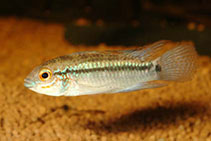
|
|
photo by
Hippocampus-Bildarchiv |
| Family: | Cichlidae (Cichlids), subfamily: Geophaginae | |||
| Max. size: | 3.44 cm SL (male/unsexed); 2.82 cm SL (female) | |||
| Environment: | benthopelagic; freshwater | |||
| Distribution: | South America: Rio Pintuyacu, a tributary of the Rio Itaya in Peru. | |||
| Diagnosis: | Dorsal spines (total): 16-16; Dorsal soft rays (total): 7-7; Anal spines: 3-3; Anal soft rays: 6-7; Vertebrae: 25-25. Presence of prominent dark blotch on the lower caudal peduncle, present in both males and females; narrow lateral band; absence of lateral spot; presence of caudal spot; four dentary lateralis openings; two post-lachrymal infraorbital lateralis openings; males with produced anterior dorsal fin lappets, produced rays dorsally and ventrally in caudal fin (Ref. 53325). | |||
| Biology: | ||||
| IUCN Red List Status: | Least Concern (LC); Date assessed: 25 April 2014 Ref. (130435) | |||
| Threat to humans: | harmless | |||