
|
Apistogramma gossei Kullander, 1982 |
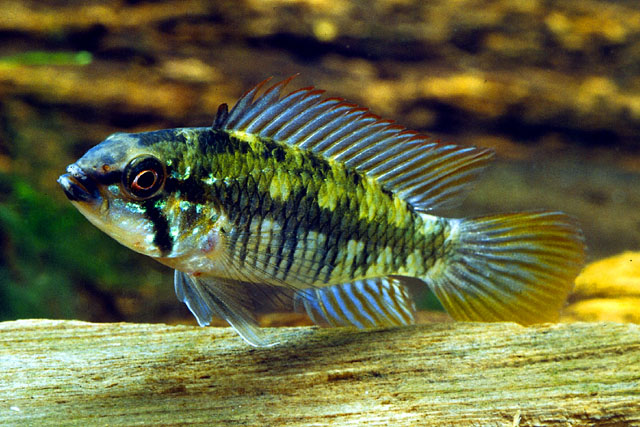
|
|
photo by
Hippocampus-Bildarchiv |
| Family: | Cichlidae (Cichlids), subfamily: Geophaginae | |||
| Max. size: | 4.4 cm SL (male/unsexed); 5 cm (female) | |||
| Environment: | benthopelagic; freshwater | |||
| Distribution: | South America: Oyapock River drainage in French Guiana and Brazil; Approuague River drainage in French Guiana. | |||
| Diagnosis: | ||||
| Biology: | Maximum length is 7.0 cm TL (Ref. 12251). Males are generally larger than females (60 cm vs. 40 cm) and have more filamentous fins and deeper coloration during reproduction (Ref. 12251). Females take care of the spawned eggs and the juveniles (Ref. 12251). | |||
| IUCN Red List Status: | Not Evaluated (N.E.) Ref. (130435) | |||
| Threat to humans: | harmless | |||