|
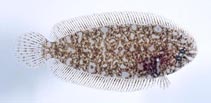
Aseraggodes cheni Randall & Senou, 2007 |
|
|
photo by
Senou, H. |
| Family: | Soleidae (Soles) | |||
| Max. size: | 7.45 cm SL (male/unsexed) | |||
| Environment: | reef-associated; marine; depth range 14 - 48 m | |||
| Distribution: | Northwest Pacific: Taiwan and Japan | |||
| Diagnosis: | Dorsal soft rays (total): 68-75; Anal soft rays: 46-51. This species is distinguished by the following characters: D 68-75; A 46-51, all branched; 73-76 lateral-line scales; 36-38 vertebrae; dorsal pterygiophores anterior to 4th neural spine 13 or 14 (only 1 with 13); body depth 2.45-2.65 SL; head length 4.5-4.65 SL; caudal-peduncle length 7.7 8.2 in head length; snout length 2.4-2.65 in head length; preorbital length 2.4-2.5 in head length; eye diameter 4.65-5.25 in head length; interorbital space narrow, 11.1-14.4 in head length; tubular anterior nostril reaching edge of eye when depressed posteriorly; longest dorsal ray 1.6-1.9 in head length; caudal fin 3.15-3.55 SL; pelvic fins reaching or nearly reaching base of 4th anal ray, 1.65-1.75 in head length, 9-16 cteni on scales, not projecting very far beyond scale margins; front edge of snout and ventral edge of head with 2 rows of lappet-like cirri; color when fresh light brown with irregular white and dark brown markings, a few white ones forming broken circles, while dark brown ones may border or partly encircle the white; 2 prominent white bands on snout and 3 extending downward from lower eye; fin rays with small dark brown spots (Ref. 74405). | |||
| Biology: | ||||
| IUCN Red List Status: | Data deficient (DD); Date assessed: 28 July 2020 Ref. (130435) | |||
| Threat to humans: | ||||