
|
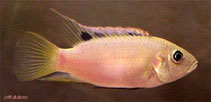
Benitochromis riomuniensis (Thys van den Audenaerde, 1981) |
|
|
photo by
Dubosc, J. |
| Family: | Cichlidae (Cichlids), subfamily: Pseudocrenilabrinae | |||
| Max. size: | 7.36 cm SL (male/unsexed) | |||
| Environment: | demersal; freshwater | |||
| Distribution: | Africa: south-western Cameroon (including Lokoundje and Kienke (=Kribi) systems and the lower Ntem), Equatorial Guinea and the Muni River (Ref. 81260). | |||
| Diagnosis: | Dorsal spines (total): 15-16; Dorsal soft rays (total): 9-10; Anal spines: 3-3; Anal soft rays: 6-8. Diagnosis: dorsal fin membrane pale, without dense black band; no strongly marked vertical bars on flanks; caudal of males with some rows of dark to reddish maculae but these never extend over entire fin; normally no markings on flanks, although stressed individuals sometimes with 2 horizontal bands; no blue iridescence on cheeks, opercle and anterior body (Ref. 81260). Description: body depth 30.2-37.3% SL; head length 34.0-37.9% SL; caudal peduncle deeper than long or slightly longer than deep; some dorsal and anal fin rays elongated; caudal rounded in both sexes (Ref. 81260). Coloration: body brown, paler ventrally (Ref. 81260). Normally no markings on flanks, although stressed individuals sometimes with 2 horizontal bands (Ref. 52307, 81260). Dorsal and upper part of caudal with red margin (Ref. 81260). Females with chrome-colored/yellow-iridescent region in soft dorsal, sometimes upper third of caudal also with such coloration (Ref. 52307, 81260), normally absent in males or, at most, reduced to a thin submargin (Ref. 52307). Caudal of males with some rows of dark to reddish maculae but these never extend over entire fin; juveniles and sometimes adults with black "tilapia spot" on the beginning of soft part dorsal; lower part of cheek and opercle with green to yellow iridescent flush; lower lips yellow (Ref. 81260). Belly of ripe females with bright rosy coloration (Ref. 52307, 81260). In males, body scales with dark margins (Ref. 52307). | |||
| Biology: | Pair-bonding, ovophilic mouthbrooder (Ref. 52307, 81260) with delayed uptake (Ref. 81260). Spawns on open substrates; both parents brood offspring (Ref. 81260). | |||
| IUCN Red List Status: | Endangered (EN); Date assessed: 16 February 2009 (B1ab(iii)+2ab(iii)) Ref. (130435) | |||
| Threat to humans: | harmless | |||