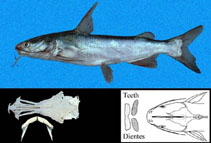
| Family: |
Ariidae (Sea catfishes), subfamily: Ariinae |
| Max. size: |
36 cm TL (male/unsexed) |
| Environment: |
demersal; freshwater; brackish; marine |
| Distribution: |
Central America: Pacific draining rivers and estuaries. |
| Diagnosis: |
Body somewhat elongate; mouth sub-terminal; cephalic plate prominent, granulated, and rough; pre-dorsal plate narrow; pre-maxillary teeth villiform; vomerine teeth lacking; palate with molariform teeth set in two separate sub-oval plates; inner edge of pectoral spine coarsely notched; caudal fin lobes long, thin, and pointed, about the same length as the head; body dark brown; belly white; flanks silvery blue (iridescent); fins dark or black; barbels dark brown (Ref. 55763). |
| Biology: |
Found in marine, brackish and fresh waters (Ref. 9271). Rarely consumed due to its small size (Ref. 9271). |
| IUCN Red List Status: |
Data deficient (DD); Date assessed: 23 May 2007 Ref. (130435)
|
| Threat to humans: |
traumatogenic |
Source and more info: www.fishbase.org. For personal, classroom, and other internal use only. Not for publication.