|
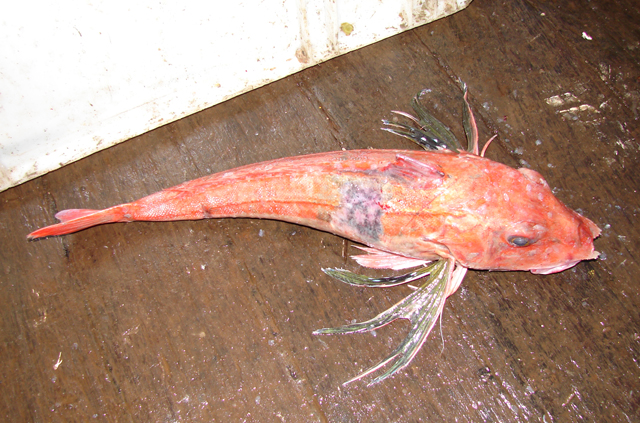
Chelidonichthys capensis (Cuvier, 1829) Cape gurnard |
|
|
photo by
Le Noury, P. |
| Family: | Triglidae (Searobins), subfamily: Triglinae | |||
| Max. size: | 75 cm TL (male/unsexed); max. reported age: 16 years | |||
| Environment: | demersal; marine; depth range 10 - 390 m | |||
| Distribution: | Southeast Atlantic and Western Indian Ocean: Cape Fria, Namibia to Maputo, Mozambique. The record of a specimen from Reunion (MHNRUN 36) is probably erroneous (Ref. 33390). | |||
| Diagnosis: | Dorsal spines (total): 8-9; Dorsal soft rays (total): 15-17; Anal spines: 0-0; Anal soft rays: 14-16 | |||
| Biology: | Found over sandy and muddy bottoms in coastal areas. Feeds on fishes (Ref. 4316) and crustaceans (Ref. 5213). Excellent food fish (Ref. 4316). | |||
| IUCN Red List Status: | Least Concern (LC); Date assessed: 21 June 2017 Ref. (130435) | |||
| Threat to humans: | harmless | |||