
|
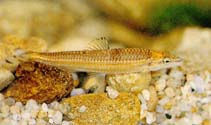
Coreoleuciscus splendidus Mori, 1935 |
|
|
photo by
Kim, I.-S. |
| Family: | Gobionidae (Gudgeons) | |||
| Max. size: | 15 cm TL (male/unsexed) | |||
| Environment: | demersal; freshwater | |||
| Distribution: | Asia: South Korea. | |||
| Diagnosis: | Vertebrae: 39-40. Coreoleuciscus splendidus differs from its congener C. aeruginos by the following body coloration and shape and/or presence of black bands on dorsal, anal and caudal fin rays: golden line immediately above a luteous line that runs along a lateral line on side of body (vs. bluish-green line above the luteous line); bright yellow line immediately above a violet and bluish line running along lateral line on side body during spawning season (vs. a luteous line immediately above a black line present during the spawning season); dorsal fin with a thick and discontinuous distal band and a thick and continuous basal band (vs. with a thin and continuous band both distally and basally); anal fin with quite thick and long distal dark band and short basal band (vs. anal fin with thin and relatively short distal band and without basal band); caudal fin with seven bands in centrosymmetric structure, three pairs of six thin bands separated into two lobes at medial and distal-most areas and a thin basal band extending outwards (vs. caudal fin with with three stripes in centrosymmetric structure, a thick and continuously band distally across lobes, one pair of two thick bands separated into two lobes medially, and a thick and short one at the basal part (Ref. 100736). Description: Dorsal-fin rays iii, 7; anal-fin rays iii, 6; pelvic-fin rays ii, 7 (Ref. 100736). | |||
| Biology: | ||||
| IUCN Red List Status: | Not Evaluated (N.E.) Ref. (130435) | |||
| Threat to humans: | harmless | |||