
|
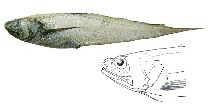
Dicrolene introniger Goode & Bean, 1883 Digitate cusk eel |
|
|
photo by
JAMARC |
| Family: | Ophidiidae (Cusk-eels), subfamily: Neobythitinae | |||
| Max. size: | 35 cm TL (male/unsexed) | |||
| Environment: | bathydemersal; marine; depth range 700 - 1785 m | |||
| Distribution: | Eastern Atlantic: continental slope all along West Africa. Western Atlantic: warmer parts of the area including the Gulf of Mexico. | |||
| Diagnosis: | Dorsal spines (total): 0-0; Dorsal soft rays (total): 100-115; Anal spines: 0-0; Anal soft rays: 85-98. Snout rather blunt; eye diameter almost as long as snout; opercular spine strong and straight; hind margin of preopercle usually with 3 sharp spines; 1 median (broad) and a pair of basibranchial tooth patches; pseudobranchial filaments 2 or 3; 7-15 developed rakers on anterior arch; lower 5-11 pectoral fin rays free and longer than upper ones; precaudal vertebrae 13-16 (Ref. 34024). No black fin rays; one supraorbital and 3 preopercular spines all strong (Ref. 34024). | |||
| Biology: | Common species (Ref. 34024). Oviparous, with oval pelagic eggs floating in a gelatinous mass (Ref. 205). | |||
| IUCN Red List Status: | Least Concern (LC); Date assessed: 08 July 2014 Ref. (130435) | |||
| Threat to humans: | harmless | |||