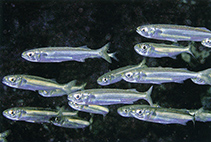
| Family: |
Atherinidae (Silversides), subfamily: Atherinomorinae |
| Max. size: |
7.2 cm SL (male/unsexed) |
| Environment: |
pelagic-neritic; brackish; marine |
| Distribution: |
Western Pacific: Thailand, the Philippines, Malaysia, Indonesia and Papua New Guinea. |
| Diagnosis: |
Dorsal spines (total): 5-8; Dorsal soft rays (total): 9-11; Anal spines: 12-14; Vertebrae: 38-42. This species is distinguished by the following combination of characters: a long spatular outgrowth on the posterior margin of most predorsal and interdorsal scales; ascending process of premaxilla is short and blunt, its height about two times maximum width, and shorter than horizontal length of premaxilla, its height about 2/5 to 1/2 of the horizontal length; premaxilla with a single lateral process; palatine with teeth; head rather large, HL 25-31% SL; upper jaw length 8.4-11% SL and 32-41% HL; midlateral band rather wide, width about 3/5-4/5 of width of midlateral scale, and its lower margin reaching to lower margin of midlateral scale row at the level of anal-fin origin (width of midlateral band 17-30% of body depth and 47-75% of caudal peduncle depth at the level of anal-fin origin. Colour of head and body faintly greenish-
tan dorsally, brilliant silver laterally; the midlateral band glossy indigo blue, upper edge with a greenish-white line; with small black dots ventrolaterally on body; snout dusky; a narrow black band along the anal-fin base; rays of second dorsal, caudal, and pectoral fins are fringed with dark dots; fin membranes hyaline (Ref. 121273). |
| Biology: |
Adults occur usually along the open coast; rarely seen in lagoons or inner parts of bays and inlets (Ref. 44256). |
| IUCN Red List Status: |
Least Concern (LC); Date assessed: 14 August 2023 Ref. (130435)
|
| Threat to humans: |
harmless |
Source and more info: www.fishbase.org. For personal, classroom, and other internal use only. Not for publication.