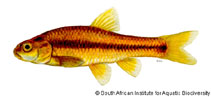
| Family: |
Cyprinidae (Minnows or carps), subfamily: Smiliogastrinae |
| Max. size: |
9.5 cm SL (male/unsexed); max. reported age: 2 years |
| Environment: |
benthopelagic; freshwater; brackish |
| Distribution: |
Africa: South Africa (restricted to the Gouritz River system, Westerrn Cape). |
| Diagnosis: |
This species is distinguished by the following characters: lateral line incomplete; pored scales rarely more than 24 (mode 8); barbels are well-developed, length reaching but not surpassing 1.8 mm (Ref. 124213).
Description: differs from congeners mandelai, cernuus by having an incomplete lateral line; with a longer pair of barbels, (average 1.61 mm (vs. oraniensis with average 0.92 mm, inconspicuous barbels); differs from amatolicus, motebensis, gurneyi by the absence of tubercles on the head during breeding season (vs. development of nuptial tubercles on either snout, lower jaw, forehead or sides of head in the other species); further differs from both gurneyi, motebensis by having a single pair of barbels (vs. two pairs of barbels in the other two species); differs amatolicus by having short barbels that do not surpass the vertical through the middle of eye (vs. distinctly long barbels that surpass vertical the through posterior edge of the eye); differs from unitaeniatus, viviparus, lineomaculatus,
barotseensis by the absence of distinct lateral line chevron markings and possession of a single pair of relatively short maxillary barbels not exceeding middle portion of eye (vs. lateral line of conspicuous chevron markings and the existence of two pairs of long and prominent barbels exceeding middle portion of the eye in the other four species); differs treurensis, breviceps, annectens, pallidus, brevipinnis, radiatus, bifrenatus by having one pair of oral barbels (vs. presence in the other species of two pairs of long barbels); differ from neefi, pallidus by the absence of two pairs of oral barbels and no dispersed black spots on the body (vs. two pairs of oral barbels and black spots on the body in these three species); differs fasciolatus by the absence of prominent vertical bars along the body (vs. present) (Ref. 124213). |
| Biology: |
It is tolerant of turbid and eutrophic habitats from foothill streams to mainstem sections of major rivers and manmade impoundments and it does not penetrate into upper reaches of mountain tributary streams with oligotrophic water (Ref. 124213). It probably feeds on insects, zooplankton, seeds, green algae and diatoms. Oviparous (Ref. 205). Breeds during summer when rivers are swollen after rain and lays adhesive eggs amongst vegetation. It is probable that it is preyed upon by larger fishes and birds like other species (see Ref. 7248 & 5214). |
| IUCN Red List Status: |
Least Concern (LC); Date assessed: 03 July 2017 Ref. (130435)
|
| Threat to humans: |
harmless |
Source and more info: www.fishbase.org. For personal, classroom, and other internal use only. Not for publication.