
|
Halichoeres dimidiatus (Agassiz, 1831) |
|
|
photo by
Wirtz, P. |
| Family: | Labridae (Wrasses), subfamily: Corinae | |||
| Max. size: | 27 cm SL (male/unsexed) | |||
| Environment: | reef-associated; marine; depth range 3 - 60 m | |||
| Distribution: | Southwest Atlantic: French Guiana to the State of São Paulo, Bazil. | |||
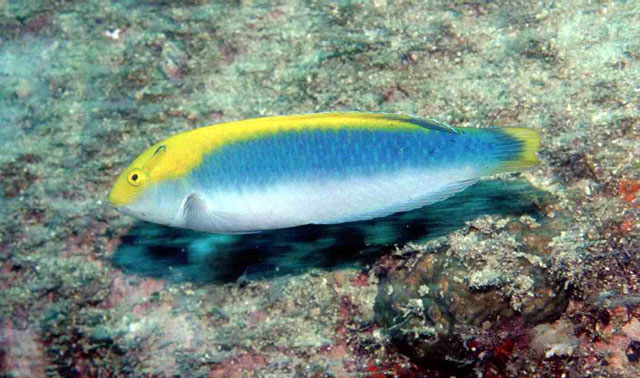
| Diagnosis: | Dorsal spines (total): 9-9; Dorsal soft rays (total): 12-12; Anal spines: 3-3; Anal soft rays: 12-12. Juveniles and females blue with a bright yellow region dorsally from mouth to posterior base of dorsal fin; caudal fin with a single dark spot. Adults with a broad blue stripe on upper half of body ending at the beginning of the caudal fin; lower half of body light blue; a diagonal dark band from eye to nape. Two pairs of enlarged canine teeth anteriorly in the lower jaw (Ref. 52607). | |||
| Biology: | Usually observed solitary; juveniles relatively common in shallow waters (3 - 20 meters) while adults are in deeper waters (30 - 60 meters) (Ref. 52607). | |||
| IUCN Red List Status: | Least Concern (LC); Date assessed: 12 March 2008 Ref. (130435) | |||
| Threat to humans: | harmless | |||