
|
Halichoeres melasmapomus Randall, 1981 Cheekspot wrasse |
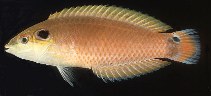
|
|
photo by
Randall, J.E. |
| Family: | Labridae (Wrasses), subfamily: Julidinae | |||
| Max. size: | 24 cm TL (male/unsexed) | |||
| Environment: | reef-associated; marine; depth range 10 - 56 m | |||
| Distribution: | Indo-Pacific: Cocos-Keeling Island and Rowley Shoals in the eastern Indian Ocean to the Marquesas and Pitcairn islands. | |||
| Diagnosis: | Dorsal spines (total): 9-9; Dorsal soft rays (total): 12-12; Anal spines: 3-3; Anal soft rays: 12-12; Vertebrae: 25-25. Fresh male specimens reddish brown dorsally, reddish ventrally; head with green bands; upper opercle with a large blue-edged black spot, rimmed with blue and red; 3 succession of spots behind eye. Large females may be similar in color with males but with a black spot on branched caudal rays; smaller ones have 3 black spots on dorsal fin base. Anterior lateral line scales with 2-7 pores, more in larger adults; 9-13 suborbital pores. Pelvic fins reaching or nearly reaching anus in large adults. | |||
| Biology: | Common around patches of rubble or mixed rubble and coral along steep drop-offs (Ref. 1602) at 10-56 m depth (Ref. 90102). Feeds on benthic invertebrates (Ref. 89972). | |||
| IUCN Red List Status: | Least Concern (LC); Date assessed: 25 March 2009 Ref. (130435) | |||
| Threat to humans: | harmless | |||