
|
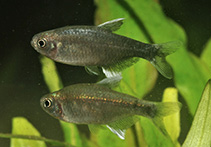
Hasemania negodagua (Lima & Gerhard, 2001) |
|
|
photo by
Hoffmann, P. and M. Hoffmann |
| Family: | Acestrorhamphidae (American tetras), subfamily: Stichonodontinae | |||
| Max. size: | 2.82 cm SL (male/unsexed) | |||
| Environment: | benthopelagic; freshwater | |||
| Distribution: | South America: upper Paraguaçú River basin. | |||
| Diagnosis: | Dorsal spines (total): 2-2; Dorsal soft rays (total): 8-9; Anal spines: 4-4; Anal soft rays: 14-17; Vertebrae: 29-32. Distinguished from most Hyphessobrycon species (except H. taurocephalus) by the absence of an adipose fin (versus presence); and by the unique, possibly autapomorphic color pattern of mature males, which consists of a high concentration of dark chromatophores, mainly on the posterior part of the body, behind a vertical through the anal-fin origin, and the white color of the distal portions of the anal and dorsal fins. | |||
| Biology: | ||||
| IUCN Red List Status: | Near Threatened (NT); Date assessed: 17 November 2018 (B1b(iii)) Ref. (130435) | |||
| Threat to humans: | harmless | |||