|
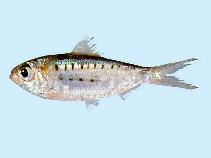
Herklotsichthys koningsbergeri (Weber & de Beaufort, 1912) Koningsberger's herring |
|
|
photo by
CSIRO |
| Family: | Dorosomatidae (Gizzard shads and sardinellas) | |||
| Max. size: | 13 cm SL (male/unsexed) | |||
| Environment: | pelagic-neritic; freshwater; brackish; marine; depth range 0 - 50 m, anadromous | |||
| Distribution: | Eastern Indian Ocean: Western Australia. Reported from the Arafura Sea (Ref. 9819). | |||
| Diagnosis: | Dorsal spines (total): 0-0; Dorsal soft rays (total): 13-21; Anal spines: 0-0; Anal soft rays: 12-23. Distinguished from all other Australian Herklotsichthys by the series of large and almost oval black spots on the flank, sometimes with a second partial row below. Herklotsichthys Species A has much smaller, round spots and is more slender, the hind edges of its scales not denticulate. Elongate wing-like scales present underneath the normal paired pre-dorsal scales. | |||
| Biology: | Forms schools in coastal waters and enters inlets and lower reaches of rivers. | |||
| IUCN Red List Status: | Least Concern (LC); Date assessed: 02 March 2017 Ref. (130435) | |||
| Threat to humans: | harmless | |||