| Family: |
Gobiidae (Gobies), subfamily: Gobiinae |
| Max. size: |
7.1 cm TL (male/unsexed); 7.8 cm TL (female) |
| Environment: |
demersal; marine; depth range 3 - 14 m |
| Distribution: |
Northwest Pacific: southern Japan, Taiwan, and Hong Kong. |
| Diagnosis: |
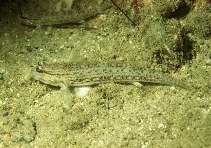
Dorsal spines (total): 7-7; Dorsal soft rays (total): 10-11; Anal spines: 1-1; Anal soft rays: 9-10; Vertebrae: 26-26. Upper pectoral fin rays entire. Predorsal cycloid scales 10-13; ctenoid on trunk. Body dusky brown with red spots; 4 blue spots on operculum; black line running from eye along sensory pore path to pectoral base; 2 dusky blotches on pectoral base, the uppermost spreading onto fin rays; large inverted `U'-shaped blotch on the cheek. In male, appressed anal fin occasionally reaching caudal fin, appressed dorsal reaching or overlapping caudal fin. Appressed anal and dorsal fins of female ending 2-3 and 1-2 scales, respectively, of caudal fin. |
| Biology: |
Common in sandy bottoms of shallow waters. Also observed to live solitarily or in small schools near crevices or under stones. Occurs at 21.5 °C (Ref. 4959). |
| IUCN Red List Status: |
Least Concern (LC); Date assessed: 21 March 2024 Ref. (130435)
|
| Threat to humans: |
harmless |
Source and more info: www.fishbase.org. For personal, classroom, and other internal use only. Not for publication.