
|
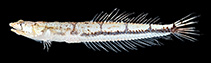
Limnichthys koreanus Lee & Kim, 2024 Korean sandburrower |
|
|
photo by
Kim, J.-K. |
| Family: | Creediidae (Sandburrowers) | |||
| Max. size: | 4.6 cm TL (male/unsexed); 4.45 cm TL (female) | |||
| Environment: | demersal; marine | |||
| Distribution: | Northwest Pacific: South Korea. | |||
| Diagnosis: | Vertebrae: 38-40. This species is distinguished by the following characters: combined number of dorsal and anal fin rays 52-55; vertebrae 38-40; lateral line scales 42-46; with a single median interorbital pore; vomerine teeth is well developed; pelvic girdle separated from each other; dorsal saddle patterns 5-9; dorsal saddles joining mid-lateral stripe 0-6 (Ref. 132280). | |||
| Biology: | Occurs in relatively thick sand substrates (or maybe more like fine gravels), usually hiding almost entirely in the sand in subtidal zone. It darts out to catch prey (e.g. copepods) and then return to their original position. Females have mature eggs in their gonads from June to August and the eggs (522 per individual) are approximately 0.62–0.65 mm in diameter. On the other hand, a specimen from December lacked developed gonads (Ref. 132280). | |||
| IUCN Red List Status: | Not Evaluated (N.E.) Ref. (130435) | |||
| Threat to humans: | harmless | |||