
|
Mugilogobius wilsoni Larson, 2001 |
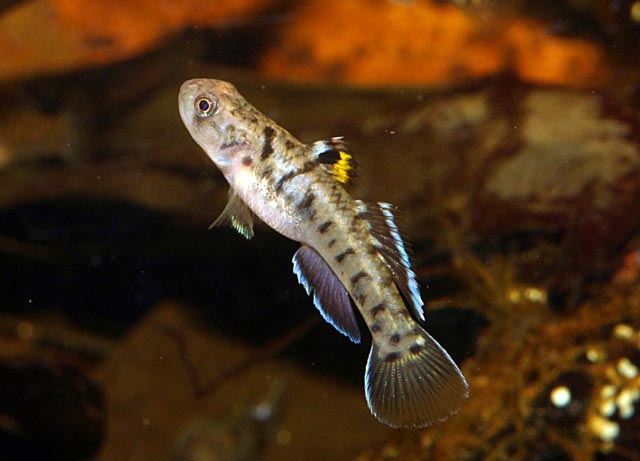
|
|
photo by
Wilson, D. |
| Family: | Gobiidae (Gobies), subfamily: Gobionellinae | |||
| Max. size: | 4 cm SL (male/unsexed) | |||
| Environment: | benthopelagic; freshwater; brackish; depth range 0 - 2 m | |||
| Distribution: | Oceania: Australia. | |||
| Diagnosis: | Dorsal spines (total): 6-7; Dorsal soft rays (total): 7-8; Anal spines: 1-1; Anal soft rays: 6-8; Vertebrae: 26-26. Body grey with 5-7 oblique black bands across sides; bands interspersed with black spots and chevron-shaped black markings; 2 oval spots on base of caudal fin (Ref. 43716). Longitudinal scales 26-31; TRB 8-13; predorsal scales 11-13, anteriormost enlarged, placed close behind eyes; scales on body mostly ctenoid; dorsal fin rounded, without elongate or filamentous spines, black spot usually on anterior half of fin (Ref. 43716). Caudal fin rounded (Ref. 43716). | |||
| Biology: | Collected mostly from tidal streams and muddy mangrove creeks and may not travel very far up into more brackish habitats. Could be kept in captivity for some weeks in seawater; can feed on live brine shrimp (Ref. 43716). Spawn in fresh water in captivity. Eggs hatch in 6-7 days at about 27°C (Ref. 44894). | |||
| IUCN Red List Status: | Least Concern (LC); Date assessed: 02 March 2020 Ref. (130435) | |||
| Threat to humans: | harmless | |||