
|
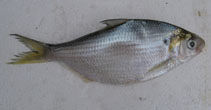
Nematalosa come (Richardson, 1846) Western Pacific gizzard shad |
|
|
photo by
Krumme, U. |
| Family: | Dorosomatidae (Gizzard shads and sardinellas) | |||
| Max. size: | 21 cm SL (male/unsexed) | |||
| Environment: | pelagic-neritic; marine; depth range - 13 m | |||
| Distribution: | Western Pacific: Ryukyu Islands to Queensland, Australia and Papua New Guinea. | |||
| Diagnosis: | Dorsal spines (total): 0-0; Anal spines: 0-0; Anal soft rays: 17-26. Belly with 18 or 19 (rarely 20) + 10 to 13 (usually 11 or 12), total 29 to 31 (usually 30) scutes. Anterior arm of pre-operculum with fleshy triangular area above, not covered by third infra-orbital bone. Edge of lower jaw strongly flared outward. Pectoral axillary scale well developed. Hind edge of scales not toothed. A dark spot behind gill opening. | |||
| Biology: | In the Trinity Inlet system, North Queensland the temperature range recorded for this fish was 26.0-29.0 °C (Ref. 4959). A filter-feeder (Ref. 188). More data needed. | |||
| IUCN Red List Status: | Least Concern (LC); Date assessed: 05 March 2017 Ref. (130435) | |||
| Threat to humans: | harmless | |||