
|
Pseudophallus elcapitanensis (Meek & Hildebrand, 1914) |
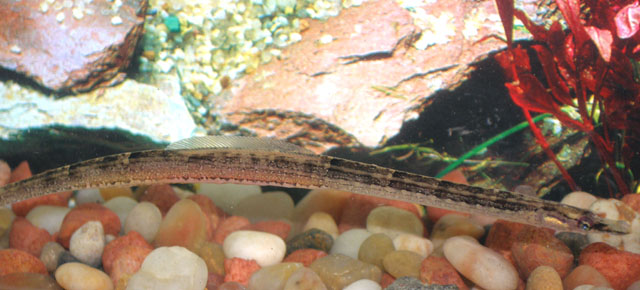
|
|
photo by
Molina, A. |
| Family: | Syngnathidae (Pipefishes and seahorses), subfamily: Syngnathinae | |||
| Max. size: | 18.5 cm SL (male/unsexed) | |||
| Environment: | benthopelagic; freshwater | |||
| Distribution: | Central America: Jiménez, Costa Rica to Rio Chico, Panama. | |||
| Diagnosis: | ||||
| Biology: | Recorded from rivers and coastal creeks of low to moderate current velocity. Generally occurs near shorelines among grasses or undergrowth. Sometimes found in tidelands near stream outlets; in rivers it reaches 20 m elevation. Food consists of small aquatic insects (Ref. 36880). Probably reaching 19-20 cm SL. Ovoviviparous (Ref. 205). The male carries the eggs in a brood pouch which is found under the tail (Ref. 205). Males may be brooding at 9-10 cm SL. | |||
| IUCN Red List Status: | Least Concern (LC); Date assessed: 26 November 2015 Ref. (130435) | |||
| Threat to humans: | harmless | |||