
|
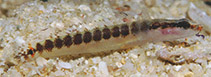
Xenisthmus eirospilus Gill & Hoese, 2004 Spotted wriggler |
|
|
photo by
Allen, G.R. |
| Family: | Xenisthmidae (Collared wrigglers) | |||
| Max. size: | 1.82 cm SL (male/unsexed); 2.12 cm SL (female) | |||
| Environment: | demersal; marine; depth range 0 - 35 m | |||
| Distribution: | Southwestern Pacific: Tasman Sea and the Solomons. | |||
| Diagnosis: | Dorsal spines (total): 7-7; Dorsal soft rays (total): 12-13; Anal spines: 1-1; Anal soft rays: 11-12; Vertebrae: 27-27. This species is characterized by the following: second dorsal-fin rays I, 12-13 (usually I, 12); A I, 11-12 (usually I, 11); vertebrae 10 + 17; indented tongue; posterior naris with well-developed flap on anterior rim; upper sides of the body with 12 large, closely spaced spots, these usually do not extend to dorsal edge of body; predorsal area broadly scaled to about vertical through posterior edge of preopercle (Ref. 59014). | |||
| Biology: | A benthic, inshore species found in coral reefs (Ref. 75154). Also found in sand patches among reefs and rubble, often in surge areas (Ref 90102). | |||
| IUCN Red List Status: | Least Concern (LC); Date assessed: 12 March 2015 Ref. (130435) | |||
| Threat to humans: | harmless | |||