Sardinella aurita, Round sardinella : fisheries, bait
This page is sponsored by
Mundus Maris

Sardinella aurita Valenciennes, 1847

Round sardinella
Thêm quan sát của bạn vào Fish Watcher
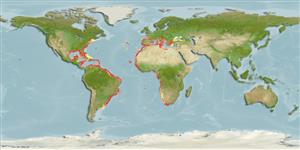
Native range | All suitable habitat | Point map | Year 2050
This map was computer-generated and has not yet been reviewed.
Sardinella aurita   AquaMaps   Data sources: GBIF OBIS
Tải lên của bạn hình ảnh Và Video
Các tranh (Ảnh) | Tem, tiền xu, v.v. | Google image
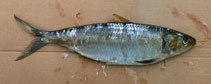
Image of Sardinella aurita (Round sardinella)
Sardinella aurita
Hình ảnh của Luyben, J.


Albania territory information

Common names: Sardele kanali, Sardelja e madhe, Sardinela
Occurrence: native
Salinity: marine
Abundance: | Ref:
Importance: | Ref:
Aquaculture: | Ref:
Regulations: | Ref:
Uses: no uses
Comments:
National Checklist:
Territory Information: https://www.cia.gov/library/publications/the-world-factbook/geos/al.html
National Fisheries Authority:
Occurrences: Occurrences Point map
Main Ref: Whitehead, P.J.P., 1985
National Database:

Common names from other countries

Phân loại / Tên Tên thường gặp | Các synonym ( Các tên trùng) | Catalog of Fishes(Giống, Các loài) | ITIS | CoL | WoRMS | Cloffa

> Clupeiformes (Herrings) > Dorosomatidae (Gizzard shads and sardinellas)
Etymology: Sardinella: Latin and Greek, sarda = sardine; name related to the island of Sardinia; diminutive (Ref. 45335).
More on author: Valenciennes.

Môi trường: môi trường / vùng khí hậu / Mức độ sâu / phạm vi phân phối Sinh thái học

biển; thuộc về nước lợ pelagic-neritic; Ở đại duơng, biển (Ref. 51243); mức độ sâu 0 - 350 m (Ref. 188). Subtropical; 18°C - 25°C (Ref. 2945); 47°N - 40°S, 98°W - 43°E (Ref. 54867)

Sự phân bố Lãnh thổ | Các khu vực của FAO | Các hệ sinh thái | Những lần xuất hiện | Bản đồ điểm | Những chỉ dẫn | Faunafri

Atlantic Ocean: West African coast (Ref. 2849, 3509, 5286, 121197) from Gibraltar southward to Saldanha Bay in South Africa (Ref. 188, 81269, 81631), especially in the three West African upwelling areas, from Mauritania to Guinea, from Côte d'Ivoire to Ghana and from Gabon to Angola (Ref. 121197); also in Mediterranean Sea (Ref. 188, 6683, 81631) and Black Sea (Ref. 188, 6683). In western Atlantic Ocean from Cape Cod in USA to Argentina (Ref. 188, 5286), including Bahamas, Antilles, Gulf of Mexico and the Caribbean coast (Ref. 26938).

Chiều dài lúc trưởng thành đầu tiên / Bộ gần gũi / Khối lượng (Trọng lượng) / Tuổi

Chín muồi sinh dục: Lm 18.8, range 13 - 25 cm
Max length : 41.0 cm TL con đực/không giới tính; (Ref. 825); common length : 25.0 cm SL con đực/không giới tính; (Ref. 188); Khối lượng cực đại được công bố: 420.00 g (Ref. 86940); Tuổi cực đại được báo cáo: 7 các năm (Ref. 839)

Mô tả ngắn gọn Khóa để định loại | Hình thái học | Sinh trắc học

Các tia vây lưng cứng (tổng cộng) : 0; Các vây lưng mềm (tổng cộng) : 17 - 20; Tia cứng vây hậu môn: 0; Tia mềm vây hậu môn: 16 - 18; Động vật có xương sống: 47 - 49. Diagnosis: Body elongate, usually subcylindrical, but sometimes a little compressed; belly rather rounded, but with a distinct keel of scutes; lower gillrakers fine and numerous, more than 80; anterior gillrakers on lower limbs of second and third gill arches lying more or less flat (Ref. 188, 2945, 81269, 81631). Flanks silvery, with a faint golden midlateral line, preceded by a faint golden spot behind gill opening; a distinct black spot at hind border of gill cover (Ref. 188). The pelvic finray count of 1 unbranched and 8 branched rays distinguishes Sardinella aurita from all other species of Sardinella, also Harengula, Opisthonema, Herklotsichthys and Amblygaster, that occur with it (Ref. 188). It resembles Clupea, but has two fleshy outgrowths along outer margin of gill opening and numerous fine fronto-parietal striae on top of head (Ref. 188).
Body shape (shape guide): elongated; Cross section: compressed.

Sinh học     Tự điển (thí dụ epibenthic)

A coastal, pelagic, species preferring clear saline waters, usually with maximum temperatures below 24°C (Ref. 27121). Found inshore and near surface to edge of shelf and down to 350m, or perhaps even deeper; schooling and strongly migratory, often rising to surface at night and dispersing (Ref. 188, 6683). It is a cold water species, temperatures between 18-25°C, approaching the coast and shoaling near the surface in the period of upwelling, but retreating below the thermocline in the hot season, down to depths of 200 to 300m (Ref. 2945, 3259). It feeds mainly on zooplankton, especially copepods and larvae of mysids, but also some phytoplankton, especially by juveniles (Ref. 188, 27121, 86940). It breeds perhaps at all times of the year, but with distinct peaks; the breeding pattern is extremely complex, with two principal spawning periods in some areas (Ref. 188). There is no spawning in Black Sea (Ref. 6683). The juveniles tend to stay in nursery areas, but on maturity rejoin adult stocks in the colder offshore waters (Ref. 188). Trematode found in intestinal tract (Ref. 37032).

Vòng đời và hành vi giao phối Chín muồi sinh dục | Sự tái sinh sản | Đẻ trứng | Các trứng | Sự sinh sản | Ấu trùng

The breeding pattern is extremely complex, with two principal spawning periods in some areas (linked with upwelling regimes off west Africa).

Tài liệu tham khảo chính Tải lên tài liệu tham khảo của bạn | Các tài liệu tham khảo | Người điều phối | Người cộng tác

Whitehead, P.J.P., 1985. FAO Species Catalogue. Vol. 7. Clupeoid fishes of the world (suborder Clupeoidei). An annotated and illustrated catalogue of the herrings, sardines, pilchards, sprats, shads, anchovies and wolf-herrings. FAO Fish. Synop. 125(7/1):1-303. Rome: FAO. (Ref. 188)

Tình trạng Sách đỏ IUCN (Ref. 130435: Version 2025-2 (Global))

  Least Concern (LC) ; Date assessed: 23 August 2012

CITES

Not Evaluated

CMS (Ref. 116361)

Not Evaluated

Mối đe dọa đối với con người

  Harmless


Sử dụng của con người

Các nghề cá: tính thương mại cao; mồi: usually
FAO - Các nghề cá: hạ cánh, hồ sơ loài; Publication: search | FIRMS - Stock assessments | FishSource | Biển chung quanh ta

Thêm thông tin

Vòng đời
Sự tái sinh sản
Chín muồi sinh dục
Độ trưởng thành/Mang liên quan
Sự sinh sản
Đẻ trứng
Tập hợp sinh sản
Các trứng
Sự phát triển của trứng
Ấu trùng
Sự biến động ấu trùng
Sự phân bố
Lãnh thổ
Các khu vực của FAO
Các hệ sinh thái
Những lần xuất hiện
Những chỉ dẫn
BRUVS - Video
Giải phẫu
Vùng mang
Não
sỏi tai
Sinh lý học
Thành phần cơ thể
Chất dinh dưỡng
Thành phần ô-xy
Kiểu bơi
Tốc độ bơi
Sắc tố thị giác
Tiếng cá
Bệnh tật & Ký sinh trùng
Độc tính (LC50)
Liên quan đến con người
Hệ thống nuôi trồng thủy sản
Các tổng quan nuôi trồng thủy sản
Các giống
Các trường hợp ngộ độc Ciguatera
Tem, tiền xu, v.v.
Tiếp cận
Người cộng tác
Các tài liệu tham khảo

Các công cụ

Báo cáo đặc biệt

Tải xuống XML

Các nguồn internet

Ước tính dựa trên mô hình

Nhiệt độ ưa thích (Tài liệu tham khảo 123201): 13.3 - 26.3, mean 18.8 °C (based on 552 cells).
Chỉ số đa dạng phát sinh loài (Tài liệu tham khảo 82804):  PD50 = 0.5000   [Uniqueness, from 0.5 = low to 2.0 = high].
Bayesian length-weight: a=0.00692 (0.00606 - 0.00789), b=3.04 (3.01 - 3.07), in cm total length, based on LWR estimates for this species (Ref. 93245).
Mức dinh dưỡng (Tài liệu tham khảo 69278):  3.4   ±0.5 se; based on diet studies.
Generation time: 2.5 (2.1 - 3.1) years. Estimated as median ln(3)/K based on 31 growth studies.
Thích nghi nhanh (Tài liệu tham khảo 120179):  Chiêù cao, thời gian nhân đôi của chủng quần tối thiểu là dưới 15 tháng (K=0.25-1.2; tm=1; tmax=7).
Prior r = 0.65, 95% CL = 0.43 - 0.98, Based on 1 full stock assessment.
Sự dễ bị tổn thương của nghề đánh cá (Ref. 59153):  Low to moderate vulnerability (29 of 100). 🛈
Sự dễ bị tổn thương của khí hậu (Ref. 125649):  Low vulnerability (7 of 100). 🛈
Loại giá (Ref. 80766):   Medium.
Chất dinh dưỡng (Ref. 124155):  Calcium = 89 [50, 191] mg/100g; Iron = 1.46 [0.87, 2.44] mg/100g; Protein = 21.6 [20.9, 22.4] %; Omega3 = 0.541 [0.271, 1.052] g/100g; Selenium = 63.2 [32.8, 112.9] μg/100g; VitaminA = 13.1 [4.2, 39.8] μg/100g; Zinc = 0.656 [0.490, 0.983] mg/100g (wet weight); based on nutrient studies.