Balistes capriscus, Grey triggerfish : fisheries, gamefish, aquarium

You can sponsor this page

Balistes capriscus Gmelin, 1789

Grey triggerfish
Adicionar sua observação em Fish Watcher
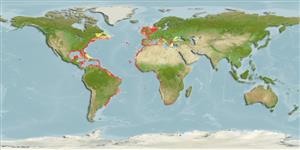
Native range | All suitable habitat | Point map | Year 2050
This map was computer-generated and has not yet been reviewed.
Balistes capriscus   AquaMaps   Data sources: GBIF OBIS
Carregue seu(sua) Fotos e vídeos
Fotos | vídeos | Selos, moedas, diversos. | Imagem do Google
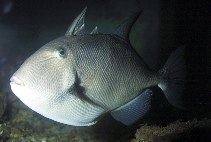
Image of Balistes capriscus (Grey triggerfish)
Balistes capriscus
Foto de Patzner, R.


Albania territory information

Common names: Peshk derr, Peshku derr
Occurrence: native
Salinity: marine
Abundance: | Ref:
Importance: | Ref:
Aquaculture: | Ref:
Regulations: | Ref:
Uses: no uses
Comments:
National Checklist:
Territory Information: https://www.cia.gov/library/publications/the-world-factbook/geos/al.html
National Fisheries Authority:
Occurrences: Occurrences Point map
Main Ref: Dhora, Dh., 2010
National Database:

Common names from other countries

Classificação / Nomes Nomes comuns | Sinônimos | Catalog of Fishes(Gênero, Espécies) | ITIS | CoL | WoRMS | Cloffa

> Tetraodontiformes (Puffers and filefishes) > Balistidae (Triggerfishes)
Etymology: Balistes: Latin, balista, -ae = crossbowman. In Greek, ballo = to throw (Ref. 45335)capriscus: Specific name 'capriscus' meaning a small goat; probably referring to its 'face' which looks like a small goat (to be confirmed).
More on author: Gmelin.

Meio ambiente: milieu / Zona climática / intervalo de profundidade / faixa de distribuição Ecologia

marinhas associadas(os) a recifes; intervalo de profundidade 0 - 100 m (Ref. 7348), usually 0 - 55 m (Ref. 55172). Tropical; 58°N - 37°S, 98°W - 36°E

Distribuição Territórios | Áreas da FAO | Ecossistemas | Ocorrências | Mapa de pontos | Introduções | Faunafri

Western and Eastern Atlantic:

Comprimento de primeira maturação / Tamanho / Peso / Idade

Maturidade: Lm 17.0, range 13 - 29.7 cm
Max length : 66.0 cm TL macho/indeterminado; (Ref. 127374); common length : 44.0 cm TL macho/indeterminado; (Ref. 47377); peso máx. publicado: 6.2 kg (Ref. 40637); idade máx. registrada: 15 anos (Ref. 107826)

Descrição suscinta Chaves de identificação | Morfologia | Morfometria

Espinhos dorsais (total) : 3; Raios dorsais (total) : 26 - 29; Espinhos anais: 0; Raios anais : 23 - 26. Tall, with a small mouth and plate like scales (Ref. 35388). Three faint irregular broad dark bars on body; a narrow pale transverse band on chin; small light blue spots on upper half of body and median fins, and irregular short lines ventrally (Ref. 13442).
Body shape (shape guide): short and / or deep.

Biologia     Glossário (p.ex. epibenthic)

Inhabits bays, harbors, lagoons, and seaward reefs (Ref. 9710). May drift with young at surface among Sargassum (Ref. 9710). Usually solitary or in small groups (Ref. 9710). Feeds on benthic invertebrates like mollusks and crustaceans (Ref. 4727). Oviparous (Ref. 205). Consumed mostly fresh, smoked, and dried salted. The flesh is of excellent quality. Because it is resistant to capture, it proliferates and competes for food with other species (Ref. 5377).

Ciclo de vida ou comportamento de acasalamento Maturidade | Reprodução | Desova | Ovos | Fecundidade | Larvas

Adults guard the embryos nested in sand which hatched in about two days (Ref. 9778).

Referência principal Carregar suas referências | Referências | Coordenador : Matsuura, Keiichi | Colaboradores

Smith-Vaniz, W.F., B.B. Collette and B.E. Luckhurst, 1999. Fishes of Bermuda: history, zoogeography, annotated checklist, and identification keys. American Society of Ichthyologists and Herpetologists Special Publication No. 4. 424 p. (Ref. 35505)

Status na Lista Vermelha da UICN (Ref. 130435: Version 2025-2 (Global))

  Vulnerável (VU) (A2bd); Date assessed: 06 June 2011

CITES

Not Evaluated

CMS (Ref. 116361)

Not Evaluated

Ameaça para os humanos

  Reports of ciguatera poisoning (Ref. 30911)


Uso pelos humanos

Pescarias: espécies comerciais; peixe esportivo: sim; Aquário: Aquários públicos
FAO - pescarias: desembarques; Publication: search | FishSource | Sea Around Us

Mais informação

Ecologia Trófica
Itens alimentares (presas)
Composição da dieta
Consumo alimentar
Rações alimentares
Predadores
Ecologia
Ecologia
Home ranges
Anatomia
Área branquial
Cérebro
Otólito
Fisiologia
Composição corporal
Nutrientes
Consumo de oxigênio
Tipo de natação
Velocidade de natação
Pigmentos visuais
Som de peixe
Doenças e Parasitas
Toxicidade (LC50s)
Genética
genoma
Genética
Heterozigosidade
Hereditariedade
Relacionado a humanos
Sistemas de aquicultura
Perfis para aquacultura
Estirpes
Casos de Ciguatera
Selos, moedas, diversos.
Divulgação
Colaboradores
Referências
Referências

Ferramentas

Relatórios especiais

Baixar XML

Fontes da internet

Estimativas baseadas em modelos

Temperatura preferida (Ref. 123201): 9 - 26.2, mean 17.8 °C (based on 1432 cells).
Índice de diversidade filogenética (Ref. 82804):  PD50 = 0.5312   [Uniqueness, from 0.5 = low to 2.0 = high].
Bayesian length-weight: a=0.02239 (0.01919 - 0.02612), b=2.88 (2.83 - 2.93), in cm total length, based on LWR estimates for this species (Ref. 93245).
Nível Trófico (Ref. 69278):  4.1   ±0.2 se; based on diet studies.
Generation time: 4.0 (2.6 - 4.8) years. Estimated as median ln(3)/K based on 20 growth studies.
Resiliência (Ref. 120179):  médio(a), tempo mínimo de duplicação da população 1,4 - 4,4 anos (K=0.18-0.43; tm=1).
Prior r = 0.37, 95% CL = 0.25 - 0.56, Based on 1 full stock assessment.
Vulnerabilidade da pesca (Ref. 59153):  Moderate to high vulnerability (46 of 100). 🛈
Vulnerabilidade climática (Ref. 125649):  Low to moderate vulnerability (32 of 100). 🛈
Categoria de preço (Ref. 80766):   High.
Nutrientes (Ref. 124155):  Calcium = 17.4 [6.5, 68.9] mg/100g; Iron = 0.507 [0.242, 1.275] mg/100g; Protein = 19.7 [18.6, 20.8] %; Omega3 = 0.212 [0.146, 0.316] g/100g; Selenium = 21.2 [8.9, 47.8] μg/100g; VitaminA = 25 [6, 111] μg/100g; Zinc = 0.5 [0.3, 0.8] mg/100g (wet weight); based on nutrient studies.