Common names from other countries
>
Eupercaria/misc (Various families in series Eupercaria) >
Sciaenidae (Drums or croakers)
Etymology: Umbrina: Latin, umbra, -ae = shadow, in the sense of phantom; due to its quick movements (Ref. 45335).
Eponymy: Don Sabas Canosa was a ‘preparater’ and later conservator at the National Museum of Montevideo, Uruguay. He was responsible for taxidermy and other forms of preservation of specimens. He also collected for the museum. (Ref. 128868), visit book page.
Taxonomic Remarks
Berg, C.
Environnement : milieu / zone climatique / profondeur / gamme de distribution
Écologie
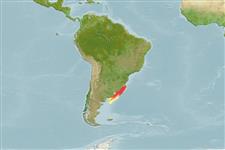
marin; saumâtre démersal; océanodrome (Ref. 51243); profondeur ? - 200 m (Ref. 47377), usually 10 - 100 m (Ref. 27363). Subtropical; 31°S - 42°S, 62°W - 49°W (Ref. 54933)
Southwest Atlantic: Cabo de São Tomé, Rio de Janeiro, Brazil to Bonaerensis, Argentina.
Longueur à la première maturité / Taille / Poids / Âge
Maturité: Lm 15.9, range 17 - ? cm
Max length : 53.3 cm TL mâle / non sexé; (Ref. 39376); common length : 37.0 cm TL mâle / non sexé; (Ref. 7025); âge max. reporté: 26 années (Ref. 7025)
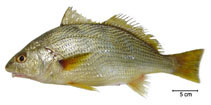
Épines dorsales (Total) : 11; Rayons mous dorsaux (Total) : 21 - 25; Épines anales: 2; Rayons mous anaux: 7 - 8. Upper part of body with many dark longitudinal stripes; no well defined dark spots at bases of pectoral fins (Ref. 27363).
Body shape (shape guide): fusiform / normal.
Especially abundant at about 100 m depth (Ref. 27363). Found over sand and mud bottoms (Ref. 47377).
Cycle de vie et comportement reproducteur
Maturité | Reproduction | Frai | Œufs | Fécondité | Larves
Haimovici, M., 1988. Cohort analysis on the Argentine croaker (Umbrina canosai) exploited in South Brazil, Uruguay and Argentina. Publ. Com. Tec. Mixta Frente Marit. Argent. Urug. 4:33-40. (Ref. 7415)
Statut dans la liste rouge de l'IUCN (Ref. 130435: Version 2025-2 (Global))
Menace pour l'homme
Harmless
Utilisations par l'homme
Pêcheries: hautement commercial
Outils
Articles particuliers
Télécharger en XML
Sources Internet
Estimations basées sur des modèles
Température préférée (Réf.
123201): 8 - 19.8, mean 14.8 °C (based on 242 cells).
Indice de diversité phylogénétique (Réf.
82804): PD
50 = 0.5000 [Uniqueness, from 0.5 = low to 2.0 = high].
Bayesian length-weight: a=0.01023 (0.00811 - 0.01291), b=3.07 (3.05 - 3.09), in cm total length, based on LWR estimates for this species (Ref.
93245).
Niveau trophique (Réf.
69278): 3.9 ±0.57 se; based on food items.
Résilience (Réf.
120179): Milieu, temps minimum de doublement de population : 1,4 à 4,4 années (K=0.26-0.27).
Vulnérabilité de la pêche (Ref.
59153): Low to moderate vulnerability (32 of 100).
🛈
Vulnérabilité climatique (Ref.
125649): Moderate to high vulnerability (49 of 100).
🛈
Nutriments (Ref.
124155): Calcium = 87.1 [46.8, 175.5] mg/100g; Iron = 1.14 [0.60, 2.03] mg/100g; Protein = 19.7 [18.6, 20.8] %; Omega3 = 0.415 [0.243, 0.670] g/100g; Selenium = 28.3 [14.6, 54.5] μg/100g; VitaminA = 18.5 [6.5, 62.6] μg/100g; Zinc = 0.746 [0.523, 1.092] mg/100g (wet weight);