Common names from other countries
分類 / 名前
共通名の | 類義語 | Catalog of Fishes(部類, 種) | ITIS | CoL | WoRMS | Cloffa
>
Cypriniformes (Carps) >
Cyprinidae (Minnows or carps) > Cyprininae
Etymology: Carassius: Latinization of , karass, karausche, European crucian carp (Ref. 45335).
More on author: Linnaeus.
環境:環境 / 気候帯 / 深さの範囲 / 分布範囲
生態学
; 新鮮な水; 汽水性の 底生の; potamodromous (Ref. 51243); 深さの範囲 5 - ? m (Ref. 2163). Temperate; 2°C - 22°C (Ref. 1672); 69°N - 35°N, 10°W - 169°E
Eurasia: North, Baltic, White, Barents, Black and Caspian Sea basins; Aegean Sea basin only in Maritza drainage; eastward to Kolyma drainage (Siberia); westward to Rhine and eastern drainages of England. Absent from North Sea basin in Sweden and Norway. In Baltic basin north to about 66°N. Widely introduced to Italy, England and France but possibly often confused with Carassius gibelio (Ref. 59043). At least one country reports adverse ecological impact after introduction.
サイズ / 重さ / 年齢
成熟: Lm ? range ? - ? cm
Max length : 64.0 cm TL オス/雌雄の選別がない; (Ref. 6114); common length : 15.0 cm TL オス/雌雄の選別がない; (Ref. 556); 最大公表体重: 3.0 kg (Ref. 556); 最大記録サイズ: 10 年 (Ref. 59043)
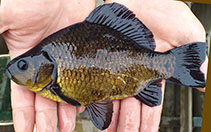
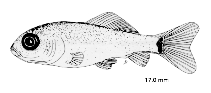
背面の脊椎 (合計) : 3 - 4; 背鰭 (合計) : 13 - 22; 肛門の骨: 2 - 3; 臀鰭: 5 - 7; 脊つい: 32. Diagnosed from its congeners in Europe by having the following characters: body golden-green shining color; last simple anal and dorsal rays weakly serrated; 23-33 gill rakers; lateral line with 31-36 scales; free edge of dorsal convex; anal fin usually with 6½ branched rays; and peritoneum white (Ref. 59043). Caudal fin with 18-20 rays (Ref. 2196). No barbels. The third dorsal and anal-fin rays are strong and serrated posteriorly.
Body shape (shape guide): fusiform / normal.
Adults occur in shallow ponds, lakes rich in vegetation and slow moving rivers. They burrow in mud in the dry season or during winter (Ref. 2163). Usually restricted to densely vegetated backwaters and oxbows of lowland rivers. Can survive at high temperatures and at very low oxygen concentrations during summer and under ice cover (Ref. 59043). Tolerates cold, organic pollutants, and low oxygen levels in the water (Ref. 30578). Feeds all day but mainly at night on plankton, benthic invertebrates, plant materials and detritus. Usually does not occur in waters with rich ichthyofauna and abundant predatory species, but very abundant in the absence of other fish species. Spawns in dense submerged vegetation (Ref. 59043). Marketed fresh and frozen; eaten fried, broiled and baked (Ref. 9988). Live up to about 10 years. There is a gradual but continuing extirpation in many water bodies, especially in Danube drainage and central Europe, possibly to due competition with introduced Carassius gibelio in non-optimal habitats (Ref. 59043).
ライフサイクルと交尾行動
成熟 | 繁殖 | 放精 | 卵 | 生産力 | 幼生
Females spawn multiple times during the spawning period (Ref. 88808). Reproduction in May-June in shallow water with dense vegetation, eggs 130000-250000/female adhere to plants, hatch after 4-8 days (Ref. 2163). Individual female spawn with several males. Males follow ripe females, often with much splashing. Eggs are sticky and are attached to water plants (Ref. 59043).
Kottelat, M. and J. Freyhof, 2007. Handbook of European freshwater fishes. Publications Kottelat, Cornol and Freyhof, Berlin. 646 pp. (Ref. 59043)
IUCNのレッドリストの状況は (Ref. 130435: Version 2025-2)
人間に対する脅威
Potential pest (Ref. 13686)
人間の用途
水産業: 高い商業の; 水産養殖: 商業; ゲームフィッシュ: はい; 水族館・水槽: 商業; 餌: occasionally
用具
特記事項
XMLをダウンロードして下さい
インターネットの情報源
モデルに基づく推定値
系統多様性指数 (参照
82804): PD
50 = 0.5156 [Uniqueness, from 0.5 = low to 2.0 = high].
Bayesian length-weight: a=0.01349 (0.01051 - 0.01732), b=3.04 (3.00 - 3.08), in cm total length, based on LWR estimates for this species (Ref.
93245).
栄養段階 (参照
69278): 3.1 ±0.24 se; based on food items.
Generation time: 3.7 ( na - na) years. Estimated as median ln(3)/K based on 1
growth studies.
回復力 (参照
120179): 手段, 1.4年~4.4年の倍増期間の最小個体群 (tm=2).
漁業の脆弱性 (Ref.
59153): Moderate vulnerability (39 of 100).
🛈
栄養素 (Ref.
124155): Calcium = 62.5 [31.5, 123.0] mg/100g; Iron = 0.784 [0.377, 1.500] mg/100g; Protein = 18 [17, 19] %; Omega3 = 0.677 [0.337, 1.373] g/100g; Selenium = 10.7 [4.8, 22.1] μg/100g; VitaminA = 17.6 [5.6, 57.2] μg/100g; Zinc = 0.557 [0.379, 0.821] mg/100g (wet weight); based on
nutrient studies.