Common names from other countries
>
Cypriniformes (Carps) >
Cyprinidae (Minnows or carps) > Cyprininae
Etymology: Carassius: Latinization of , karass, karausche, European crucian carp (Ref. 45335).
More on author: Linnaeus.
Ambiente: milieu / zona climática / intervalo de profundidade / gama de distribuição
Ecologia
; Água doce; estuarina demersal; potamódromo (Ref. 51243); intervalo de profundidade 5 - ? m (Ref. 2163). Temperate; 2°C - 22°C (Ref. 1672); 69°N - 35°N, 10°W - 169°E
Eurasia: North, Baltic, White, Barents, Black and Caspian Sea basins; Aegean Sea basin only in Maritza drainage; eastward to Kolyma drainage (Siberia); westward to Rhine and eastern drainages of England. Absent from North Sea basin in Sweden and Norway. In Baltic basin north to about 66°N. Widely introduced to Italy, England and France but possibly often confused with Carassius gibelio (Ref. 59043). At least one country reports adverse ecological impact after introduction.
Tamanho / Peso / Idade
Maturidade: Lm ? range ? - ? cm
Max length : 64.0 cm TL macho/indeterminado; (Ref. 6114); common length : 15.0 cm TL macho/indeterminado; (Ref. 556); peso máx. Publicado: 3.0 kg (Ref. 556); Idade máx. registada: 10 anos (Ref. 59043)
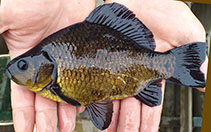
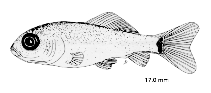
Espinhos dorsais (total) : 3 - 4; Raios dorsais moles (total) : 13 - 22; Espinhos anais: 2 - 3; Raios anais moles: 5 - 7; Vértebras: 32. Diagnosed from its congeners in Europe by having the following characters: body golden-green shining color; last simple anal and dorsal rays weakly serrated; 23-33 gill rakers; lateral line with 31-36 scales; free edge of dorsal convex; anal fin usually with 6½ branched rays; and peritoneum white (Ref. 59043). Caudal fin with 18-20 rays (Ref. 2196). No barbels. The third dorsal and anal-fin rays are strong and serrated posteriorly.
Body shape (shape guide): fusiform / normal.
Adults occur in shallow ponds, lakes rich in vegetation and slow moving rivers. They burrow in mud in the dry season or during winter (Ref. 2163). Usually restricted to densely vegetated backwaters and oxbows of lowland rivers. Can survive at high temperatures and at very low oxygen concentrations during summer and under ice cover (Ref. 59043). Tolerates cold, organic pollutants, and low oxygen levels in the water (Ref. 30578). Feeds all day but mainly at night on plankton, benthic invertebrates, plant materials and detritus. Usually does not occur in waters with rich ichthyofauna and abundant predatory species, but very abundant in the absence of other fish species. Spawns in dense submerged vegetation (Ref. 59043). Marketed fresh and frozen; eaten fried, broiled and baked (Ref. 9988). Live up to about 10 years. There is a gradual but continuing extirpation in many water bodies, especially in Danube drainage and central Europe, possibly to due competition with introduced Carassius gibelio in non-optimal habitats (Ref. 59043).
Females spawn multiple times during the spawning period (Ref. 88808). Reproduction in May-June in shallow water with dense vegetation, eggs 130000-250000/female adhere to plants, hatch after 4-8 days (Ref. 2163). Individual female spawn with several males. Males follow ripe females, often with much splashing. Eggs are sticky and are attached to water plants (Ref. 59043).
Kottelat, M. and J. Freyhof, 2007. Handbook of European freshwater fishes. Publications Kottelat, Cornol and Freyhof, Berlin. 646 pp. (Ref. 59043)
Categoria na Lista Vermelha da IUCN (Ref. 130435: Version 2025-2)
Ameaça para o homem
Potential pest (Ref. 13686)
Utilização humana
Pescarias: altamente comercial; Aquacultura: espécies comerciais; peixe desportivo: sim; Aquário: Espécies comerciais; isco: occasionally
Ferramentas
Relatórios especiais
Descarregue XML
Fontes da internet
Estimativas baseadas em modelos
Índice de diversidade filogenética (Ref.
82804): PD
50 = 0.5156 [Uniqueness, from 0.5 = low to 2.0 = high].
Bayesian length-weight: a=0.01349 (0.01051 - 0.01732), b=3.04 (3.00 - 3.08), in cm total length, based on LWR estimates for this species (Ref.
93245).
Nível Trófico (Ref.
69278): 3.1 ±0.24 se; based on food items.
Generation time: 3.7 ( na - na) years. Estimated as median ln(3)/K based on 1
growth studies.
Resiliência (Ref.
120179): Médio, tempo mínimo de duplicação da população 1,4 - 4,4 anos (tm=2).
Vulnerabilidade da pesca (Ref.
59153): Moderate vulnerability (39 of 100).
🛈
Nutrientes (Ref.
124155): Calcium = 62.5 [31.5, 123.0] mg/100g; Iron = 0.784 [0.377, 1.500] mg/100g; Protein = 18 [17, 19] %; Omega3 = 0.677 [0.337, 1.373] g/100g; Selenium = 10.7 [4.8, 22.1] μg/100g; VitaminA = 17.6 [5.6, 57.2] μg/100g; Zinc = 0.557 [0.379, 0.821] mg/100g (wet weight); based on
nutrient studies.