Eutrigla gurnardus, Grey gurnard : fisheries

You can sponsor this page

Eutrigla gurnardus (Linnaeus, 1758)

Grey gurnard
Masukkan pemerhatian anda di Fish Watcher
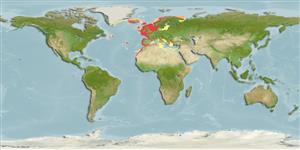
Native range | All suitable habitat | Point map | Year 2050
This map was computer-generated and has not yet been reviewed.
Eutrigla gurnardus   AquaMaps   Data sources: GBIF OBIS
muatnaik fotos/gambar dan video
Gambar | video | Suara-suara | imej Google
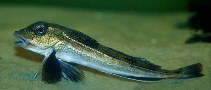
Image of Eutrigla gurnardus (Grey gurnard)
Eutrigla gurnardus
foto/gambar oleh JJPhoto

Common names from other countries

klasifikasi / Names Nama-nama umum | Sinonim (persamaan) | Catalog of Fishes(Marga, Jenis) | ITIS | CoL | WoRMS | Cloffa

> Perciformes/Scorpaenoidei (Scorpionfishes) > Triglidae (Searobins) > Triglinae
Etymology: Eutrigla: Greek, eu = good + Greek, trigla, es = red mullet + greek (Ref. 45335).
More on author: Linnaeus.

Environment: milieu / climate zone / kisaran kedalaman / distribution range Ekologi

laut; payau dasar (demersal); kisaran kedalaman 10 - 340 m (Ref. 56504), usually 10 - 150 m (Ref. 35388). Temperate; 71°N - 21°N, 49°W - 42°E

Penyebaran Negara-negara | Daerah-daerah FAO | Ecosystems | Kemunculan | peta titik | Introduksi | Faunafri

Eastern Atlantic: Norway to Morocco, Madeira, Iceland (Ref. 2723), including Greenland (Ref. 115160). Also known from the Mediterranean and Black Sea (Ref. 4697).

Length at first maturity / Size / Weight / umur

Kematangan: Lm 18.8, range 24 - ? cm
Max length : 60.0 cm TL jantan/; (Ref. 3397); common length : 30.0 cm TL jantan/; (Ref. 4697); Berat maksimum terpublikasi: 956.00 g (Ref. 41256)

deskripsi pendek Kunci identifiaksi (pengenalan) | Morfologi | Morfometrik

Head large without deep occipital groove. Vertebrae 37-39 (11-13 precaudal and 25-27 caudal).
Body shape (shape guide): elongated.

Biologi     Daftar kata (contoh epibenthic)

Common on sandy grounds, sometimes on rocky bottoms, and also on mud between coastline to 140 m depth. Up to depth of 340 m in the eastern Ionian Sea (Ref. 56504). Feeds on crustaceans, mostly shrimps and shore crabs; fishes, mostly gobies, flatfish, young herring and sand eels. Makes croaking sounds (Ref. 9987). Utilized fresh and frozen; eaten fried and baked (Ref. 9987).

Life cycle and mating behavior Kematangan | Reproduksi, perkembang biakan | Pemijahan | telur-telur | Fecundity | Larva

The young are pelagic until attaining a length of 3 cm.

rujukan utama Upload your references | Acuan | Koordinator | mitra

Bauchot, M.-L., 1987. Poissons osseux. p. 891-1421. In W. Fischer, M.L. Bauchot and M. Schneider (eds.) Fiches FAO d'identification pour les besoins de la pêche. (rev. 1). Méditerranée et mer Noire. Zone de pêche 37. Vol. II. Commission des Communautés Européennes and FAO, Rome. (Ref. 3397)

Status IUCN Red List (Ref. 130435: Version 2025-1)


CITES

Not Evaluated

CMS (Ref. 116361)

Not Evaluated

ancaman kepada manusia

  Harmless


penggunaan manusia

Perikanan: komersial
FAO - Perikanan: landings, profail spesis; Publication: search | FishSource | Sea Around Us

informasi lanjut

Trophic ecology
Food items (preys)
Komposisi makanan
Konsumsi makanan
Food rations
Pemangsa
Ekologi
Ekologi
Home ranges
Life cycle
Reproduksi, perkembang biakan
Kematangan
Maturity/Gills rel.
Fecundity
Pemijahan
Spawning aggregations
telur-telur
pekembangan telor
Larva
Dinamika larva
Penyebaran
Negara-negara
Daerah-daerah FAO
Ecosystems
Kemunculan
Introduksi
BRUVS - Videos
Anatomy
Area insang
Brain
Otolith
Physiology
Body composition
Nutrients
Oxygen consumption
Swimming type
Swimming speed
Visual pigments
Fish sound
Diseases & Parasites
Toxicity (LC50s)
Genetika
genom
Genetika
Heterozygosity
Diturunkan
Human related
Aquaculture systems
profil budidaya air
Strain
Ciguatera cases
Stamps, coins, misc.
Outreach
mitra
Acuan
Acuan

Alat, peralatan

laporan khas

muat turun XML

Sumber internet

AFORO (otoliths) | Aquatic Commons | BHL | Cloffa | Websites from users | semak peneliti ikan | CISTI | Catalog of Fishes: Marga, Jenis | DiscoverLife | ECOTOX | FAO - Perikanan: landings, profail spesis; Publication: search | Faunafri | Fishipedia | Fishtrace | GloBI | Google Books | Google Scholar | Google | IGFA World Record | Pangkalan data nasional | OneZoom | Open Tree of Life | Otolith Atlas of Taiwan Fishes | Akuarium publik | PubMed | Reef Life Survey | Socotra Atlas | TreeBase | Tree of Life | Wikipedia: pergi, Cari | World Records Freshwater Fishing | Zoological Record

Estimates based on models

Preferred temperature (Acuan 123201): 7.3 - 13.5, mean 10.1 °C (based on 1378 cells).
Phylogenetic diversity index (Acuan 82804):  PD50 = 1.0000   [Uniqueness, from 0.5 = low to 2.0 = high].
Bayesian length-weight: a=0.00692 (0.00575 - 0.00832), b=3.04 (2.98 - 3.10), in cm total length, based on LWR estimates for this species (Ref. 93245).
Trophic level (Acuan 69278):  3.9   ±0.0 se; based on diet studies.
Generation time: 6.9 ( na - na) years. Estimated as median ln(3)/K based on 1 growth studies.
Daya lenting (Acuan 120179):  Rendah, Waktu penggandaan populasi minimum 4.5 - 14 tahun (K=0.16; tm=3-4; tmax=21; Fec=200,000).
Prior r = 0.74, 95% CL = 0.49 - 1.10, Based on 1 data-limited stock assessment.
Fishing Vulnerability (Ref. 59153):  High vulnerability (55 of 100). 🛈
Climate Vulnerability (Ref. 125649):  Low to moderate vulnerability (27 of 100). 🛈
kategori harga (Ref. 80766):   High.
Nutrients (Ref. 124155):  Calcium = 42.8 [23.8, 88.7] mg/100g; Iron = 0.431 [0.232, 0.773] mg/100g; Protein = 17.6 [15.9, 19.4] %; Omega3 = 0.682 [0.312, 1.889] g/100g; Selenium = 21.1 [10.6, 47.8] μg/100g; VitaminA = 12.8 [4.8, 37.7] μg/100g; Zinc = 0.494 [0.355, 0.707] mg/100g (wet weight);