Common names from other countries
>
Salmoniformes (Salmons) >
Salmonidae (Salmonids) > Salmoninae
Etymology: Oncorhynchus: Greek, onyx, -ychos = nail + Greek, rhyngchos = snout (Ref. 45335); nerka: nerka which is the Russian name for the anadromous form (Ref. 1998).
More on author: Walbaum.
محیط زیست: محیط زیست / منطقه آب و هوایی / تغييرات عمق / محدوده توزیع
بوم شناسي
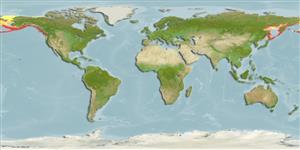
دريايي; آب شيرين; لب شور pelagic-oceanic; رود کوچ (Ref. 132363); تغييرات عمق 0 - 250 m (Ref. 50550). Temperate; 0°C - 25°C (Ref. 35682); 72°N - 42°N, 130°E - 109°W (Ref. 117423)
North Pacific: northern Japan to Bering Sea and to Los Angeles, California, USA (Ref. 2850). Artic and Pacific drainages from Point Hope in Alaska to Columbia River drainage in Oregon and Idaho in USA. Landlocked populations in Alaska, Yukon Territory and British Columbia in Canada, and Washington, Oregon, and California in USA (Ref. 86798).
طول در اولین بلوغ / اندازه / وزن / سن
بلوغ: Lm 60.0 range ? - ? cm
Max length : 84.0 cm TL جنس نر / بدون خواص جنسي; (Ref. 86798); 71.0 cm (female); common length : 45.0 cm TL جنس نر / بدون خواص جنسي; (Ref. 9988); common length :58 cm (female); بيشينه وزن گزارش شده: 7.7 kg (Ref. 40637); بيشينه سن گزارش شده: 8 سال ها (Ref. 72462)
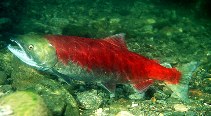
خارهاي باله پشتي (کل) : 0; شعاع نرم باله پشتي (کل) : 11 - 16; خارهاي باله مخرجي: 0; شعاع نرم باله مخرجي: 13 - 18; مهره ها: 56 - 67. Both the sockeye and the kokanee are distinguished by the long, fine, serrated, closely spaced gill rakers on the first arch that number between 30 and 40, and by its lack of definite spot on the back and tail (Ref. 27547). Body fusiform, streamlined, laterally compressed, body depth moderate, slightly deeper in breeding males (Ref. 6885). Head bluntly pointed, conical, eye rather small, position variable with sex and condition; snout rather pointed (Ref. 6885). Lateral line straight (Ref. 27547). Pelvic fins with axillary process; caudal emarginate (Ref. 27547). Pre-spawning fish are dark steel blue to greenish blue on the head and back, silvery on the sides and white to silvery on the belly; no definite spots on the back, although some individuals may have dark speckling and irregular marks on the dorsal fin (Ref. 27547). At spawning, the head of the males becomes bright to olive green, with black on the snout and upper jaw; the adipose and anal fins turn red and the paired fins and tail generally become grayish to green or dark; females are generally less brilliantly colored than males (Ref. 27547). Various populations may show less brilliant colors, and a few turn dull green to yellowish, with little if any red (Ref. 27547).
Body shape (shape guide): fusiform / normal; Cross section: compressed.
Epipelagic (Ref. 58426). Occurs in open ocean and lakes and migrates up to coastal streams to spawn (Ref. 86798). There are two forms, the anadromous form known as the sockeye and the landlocked form (with a much smaller maximum size) known as the kokanee (Ref. 27547). Upon emergence from gravel, fry at first tends to avoid light, hiding during the day and emerging at night (Ref. 27547). In some populations, sockeye fry go to the sea during their first summer but most spend one or two (rarely three or four) years in a lake before migrating (Ref. 30333). In a few streams of the Copper River drainage in Alaska, young sockeye stay in the stream (Ref. 27547). Once in the lake, the young spend a few weeks inshore, feeding largely on ostracods, cladocerans and insect larvae. The fish then become pelagic and move offshore, where they feed on plankton in the upper 20 m or so (Ref. 27547). Seaward migration follows with the young individuals first staying fairly close to shore, feeding mainly on zooplankton, but also on small fishes and insects (Ref. 30343, 30346). With growth, they head out to sea and fish become important in the diet (Ref. 27547). Kokanee are confined to lake-stream systems, and most of its life is spent in the lake (Ref. 27547). They feed mainly on plankton, but also take insects and bottom organisms (Ref. 1998). Kokanee, wherever they are native, have been derived from anadromous populations, and each kokanee population apparently has evolved independently from a particular sockeye run (Ref. 30338, 30339). Offspring of kokanee occasionally become anadromous, and sockeye offspring occasionally remain in freshwater (Ref. 27547). Lifespan of the kokanee varies from two to seven years in different stocks (Ref. 27547). The sockeye is one of the most commercially important Pacific salmons; the kokanee is primarily a sport fish but also makes excellent food and in some areas well regarded as food for large trout (Ref. 27547). Marketed fresh, dried or salted, smoked, canned, and frozen; eaten steamed, fried, broiled, microwaved, and baked (Ref. 9988).
Adult sockeyes return to natal streams to spawn. This occurs during summer and fall and as late as December in the southern part of the range. The female selects a site, usually with gravel bottom, and digs a nest. During nest building, the female is attended by a dominant male and a few subordinate males. At this stage, females tend to be aggressive toward other females and subordinate males; males are aggressive toward other males. Between digging acts, the female will rest over the pit while the dominant male courts her. Once the nest is completed, the female enters the nest, followed immediately by the dominant male who comes close beside her. Their mouths gape, and the pair vibrates to release eggs and sperm. One or more subordinate males may come to the other side of the female and join in the spawning. The female then moves to the upstream edge of the nest and digs again, covering the old nest, at the same time creating a new one just upstream from the previous one. A female normally needs 3 to 5 days to deposit all her eggs and utilizes 3 to 5 nests for this purpose. She may spawn with several dominant males. A male may breed with several females. All adult sockeye die after spawning (Ref. 27547).
Reproductive strategy: synchronous ovarian organization, determinate fecundity (Ref. 51846).
Page, L.M. and B.M. Burr, 2011. A field guide to freshwater fishes of North America north of Mexico. Boston : Houghton Mifflin Harcourt, 663p. (Ref. 86798)
وضعيت در فهرست قرمز IUCN (Ref. 130435: Version 2025-2 (Global))
خطر برای انسان ها
Harmless
استفاده انسانی
ماهي گيري – شيلات: با ارزش تجاري بالا; آبزي پروري: تجاري; ماهي ها ي سرگرم كننده: بله; آكواريوم: آکواریوم عمومی
ابزارها
گزارش های ويژه
بارگيری XML
منابع اينترنتي
تخمینها بر اساس مدلها
دمای ترجیحی (مرجع
123201): 1 - 8.4, mean 4.2 °C (based on 374 cells).
شاخص تنوع فیلوژنتیکی (مرجع
82804): PD
50 = 0.5000 [Uniqueness, from 0.5 = low to 2.0 = high].
Bayesian length-weight: a=0.01047 (0.00488 - 0.02245), b=3.04 (2.87 - 3.21), in cm total length, based on LWR estimates for this Genus-body shape (Ref.
93245).
سطح تروفیک (مرجع
69278): 3.5 ±0.2 se; based on diet studies.
Generation time: 2.9 ( na - na) years. Estimated as median ln(3)/K based on 2
growth studies.
جهندگی (مرجع
120179): متوسط, كمينه زمان لازم براي دو برابر شدن جمعيت 4/1 – 4/4 سال (K=0.37-0.58; tm=2-4; tmax=7; Fec=300).
Prior r = 0.50, 95% CL = 0.33 - 0.76, Based on 5 full stock assessments.
آسیبپذیری ماهیگیری (Ref.
59153): Low to moderate vulnerability (29 of 100).
🛈
آسیبپذیری اقلیمی (Ref.
125649): High to very high vulnerability (72 of 100).
🛈
مواد مغذی (Ref.
124155): Calcium = 24.7 [6.9, 74.5] mg/100g; Iron = 0.554 [0.235, 1.400] mg/100g; Protein = 19.2 [17.9, 20.4] %; Omega3 = 1.94 [0.87, 4.43] g/100g; Selenium = 80.4 [22.8, 318.9] μg/100g; VitaminA = 9.13 [2.62, 33.21] μg/100g; Zinc = 0.472 [0.271, 0.940] mg/100g (wet weight);