Thunnus thynnus, Atlantic bluefin tuna : fisheries, aquaculture, gamefish

You can sponsor this page

Thunnus thynnus (Linnaeus, 1758)

Atlantic bluefin tuna
Añada su observación en Fish Watcher
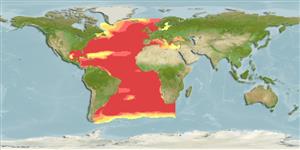
Native range | All suitable habitat | Point map | Year 2050
This map was computer-generated and has not yet been reviewed.
Thunnus thynnus   AquaMaps   Data sources: GBIF OBIS
Sube tu fotos y Vídeos
Imágenes | Vídeos | Sellos, monedas, varios | Google image
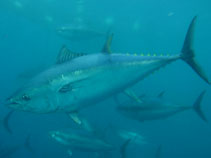
Image of Thunnus thynnus (Atlantic bluefin tuna)
Thunnus thynnus
Foto de Ticina, V.


Cabo Verde territory information

Common names: Atuarro, Atum-azul, Atum-de-direito
Occurrence: native
Salinity: marine
Abundance: | Ref:
Importance: | Ref:
Aquaculture: | Ref:
Regulations: | Ref:
Uses: no uses
Comments: Also Ref. 27000. Not recorded in Ref. 168 (Collette & Nauen, 1983) and old fishery records of this species are almost certainly mistaken records (Ref. 94080).
National Checklist:
Territory Information: https://www.cia.gov/library/publications/resources/the-world-factbook/geos/cv.html
National Fisheries Authority:
Occurrences: Occurrences Point map
Main Ref: Wirtz, P., A. Brito, J.M. Falcón, R. Freitas, R. Fricke, V. Monteiro, F. Reiner and O. Tariche, 2013
National Database:

Common names from other countries

Clasificación / Nombres Nombres comunes | Sinónimos | Catalog of Fishes(Género, Especie) | ITIS | CoL | WoRMS | Cloffa

> Scombriformes (Mackerels) > Scombridae (Mackerels, tunas, bonitos) > Scombrinae
Etymology: Thunnus: Greek, thynnos = tunna (Ref. 45335).
More on author: Linnaeus.

Entorno: milieu / zona climática / rango de profundidad / gama de distribución Ecología

marino; salobre pelagic-oceanic; oceanodromo (Ref. 71039); rango de profundidad 0 - 985 m (Ref. 55291), usually 0 - 100 m. Subtropical; 3°C - 30°C (Ref. 88796); 69°N - 58°S, 99°W - 42°E

Distribución Territorios | Áreas FAO | Ecosistemas | Ocurrencias, apariciones | Mapa de puntos | Introducciones | Faunafri

Western Atlantic: Labrador and Newfoundland to Gulf of Mexico, and Caribbean Sea to Venezuela and Brazil. Eastern Atlantic: Lofoten Islands off Norway to Canary Islands, including the Mediterranean and the southern part of the Black Sea (Ref. 6769). Reported from Mauritania (Ref. 5377). There is a subpopulation off South Africa. Highly migratory species.

Longitud en la primera madurez / Tamaño / Peso / Edad

Madurez: Lm 103.5, range 97 - 110 cm
Max length : 458 cm TL macho / no sexado; (Ref. 26340); common length : 200 cm FL macho / no sexado; (Ref. 168); peso máximo publicado: 684.0 kg (Ref. 26340); edad máxima reportada: 32 años (Ref. 5810)

Descripción breve Claves de identificación | Morfología | Morfometría

Espinas dorsales (total) : 12 - 14; Radios blandos dorsales (total) : 13 - 15; Espinas anales: 0; Radios blandos anales: 13 - 16; Vértebra: 39. A very large species, deepest near the middle of the first dorsal fin base. The second dorsal fin higher than the first; the pectoral fins are very short, less than 80% of head length. Swim bladder present. Lower sides and belly silvery white with colorless transverse lines alternated with rows of colorless dots. The first dorsal fin is yellow or bluish; the second reddish-brown; the anal fin and finlets dusky yellow and edged with black; the median caudal keel is black in adults. May be confused with several other tunas, these are typically much smaller and easily distinguished by specific patterns of stripes, bands or dots.
Body shape (shape guide): fusiform / normal; Cross section: oval.

Biología     Glosario (por ej. epibenthic)

Oceanic but seasonally coming close to shore. They school by size, sometimes together with albacore, yellowfin, bigeye, skipjack etc. Visual predators (Ref. 88866) preying on small schooling fishes (anchovies, sauries, hakes) or on squids and red crabs. Live up to 40 years in the western Atlantic (Ref. 88822). Weight up to 900 kg (Ref. 88823). Eggs and larvae are pelagic (Ref. 6769). Juvenile growth is rapid (about 30 cm / year) but slower than in other tuna and billfish species (Ref. 88867). Adult growth is considerably slower, with about 10 years needed to reach two thirds of maximum length. Become rare because of massive overfishing (Ref. 35388).

Ciclo vital y comportamiento de apareamiento Madurez | Reproducción | Puesta | Huevos | Fecundidad | Larva

Oviparous batch spawner, with an inter-spawning interval of 1-2 days in the Mediterranean Sea (Ref. 88871). Females larger than 205 cm fork length are estimated to have a mean fecundity of 30-60 and 13-15 million eggs, in the western and eastern Atlantic respectively (Ref. 40805, Ref. 88871). Spawning occurs when sea surface temperatures are between 22.6-27.5 ºC and 22.5-25.5 ºC in the Gulf of Mexico and Mediterranean Sea respectively (88868). Spawning occurs between June and August in the Mediterranean Sea (Ref. 88868). Eggs are released directly to the water column and hatch after 2 days (Ref. 88823). At 24°C, embryo development lasts about 32 hours and larval stages about 30 days. Egg size 1.0 mm, larval length at hatching 2.8 mm. Spawning grounds are mainly known from the Gulf of Mexico and the Mediterranean Sea, but the presence of mature individuals and larvae far from these areas (e.g. Bahamas and central North Atlantic Ocean) suggest that other spawning grounds may also be utilized (Ref. 88873, Ref. 88874, Ref. 88872). Appears to display homing behaviour with (western-tagged individuals migrating back to specific spawning sites either in the Gulf of Mexico or the Mediterranean Sea) (Ref. 88872, Ref. 88870). Fidelity to natal areas seem to occur once individuals reach maturity, i.e. after returning to either the western or eastern spawning grounds (Ref. 88868).

Referencia principal Suba sus referencias | Referencias | Coordinador : Collette, Bruce B. | Colaboradores

Collette, B.B., 1999. Mackerels, molecules, and morphology. p. 149-164. In B. Séret and J.-Y. Sire (eds.) Proc. 5th Indo-Pac. Fish Conf., Noumea, Paris. (Ref. 33246)

Situación en la Lista Roja de la UICN (Ref. 130435: Version 2025-2)

  Least Concern (LC) ; Date assessed: 15 January 2021

CITES

Not Evaluated

CMS (Ref. 116361)

Not Evaluated

Amenaza para el ser humano

  Harmless


Usos humanos

Pesquerías: comercial; Acuicultura: comercial; pesca deportiva: si
FAO - Sistemas de acuicultura: producción; pesquerías: desembarques, perfil de la especie; Publication: search | FIRMS - Stock assessments | FishSource | Sea Around Us

Más información

Anatomía
Superficie branquial
Cerebro
Otolito
Fisiología
Composición corporal
Nutrientes
Consumo del oxígeno
Tipo de natación
Velocidad de natación
Pigmentos visuales
Sonido de peces
Enfermedades y parásitos
Toxicidad (CL50)
Genética
Genoma
Genética
Heterocigosidad
heritabilidad
Relacionados con el ser humano
Sistemas de acuicultura
Perfiles de acuicultura
Razas
Ciguatera cases
Sellos, monedas, varios
Divulgación
Colaboradores
Referencias
Referencias

Herramientas

Informes especiales

Descargar XML

Fuentes de Internet

Estimaciones basadas en modelos

Temperatura preferida (Referencia 123201): 7.5 - 24.7, mean 12.6 °C (based on 3084 cells).
Índice de diversidad filogenética (Referencia 82804):  PD50 = 0.5039   [Uniqueness, from 0.5 = low to 2.0 = high].
Bayesian length-weight: a=0.01230 (0.01003 - 0.01509), b=3.03 (2.99 - 3.07), in cm total length, based on LWR estimates for this species (Ref. 93245).
Nivel trófico (Referencia 69278):  4.5   ±0.8 se; based on diet studies.
Generation time: 12.8 (9.2 - 16.3) years. Estimated as median ln(3)/K based on 21 growth studies.
Resiliencia (Referencia 120179):  Medio, población duplicada en un tiempo mínimo de 1.4-4.4 años (tm=3-5; tmax=15; Fec=10 million).
Prior r = 0.24, 95% CL = 0.16 - 0.35, Based on 5 full stock assessments.
Vulnerabilidad pesquera (Ref. 59153):  Very high vulnerability (82 of 100). 🛈
Vulnerabilidad climática (Ref. 125649):  Moderate vulnerability (38 of 100). 🛈
Categoría de precios (Ref. 80766):   Very high.
Nutrientes (Ref. 124155):  Calcium = 13.1 [7.2, 24.7] mg/100g; Iron = 2.09 [0.85, 5.36] mg/100g; Protein = 24.2 [22.6, 25.6] %; Omega3 = 0.393 [0.229, 0.689] g/100g; Selenium = 53.2 [20.7, 152.4] μg/100g; VitaminA = 17.3 [2.2, 167.3] μg/100g; Zinc = 0.319 [0.187, 0.655] mg/100g (wet weight); based on nutrient studies.