This website uses cookies to enhance your browsing experience and ensure the functionality of our site. For more detailed information about the types of cookies we use and how we protect your privacy, please visit our Privacy Information page.
×
Cookie Settings
This website uses different types of cookies to enhance your experience. Please select your preferences below:
Teleostei (teleosts) > Perciformes/Scorpaenoidei (Scorpionfishes) > Triglidae (Searobins) > Triglinae
Etymology: Chelidonichthys:Greek, chelidon, -onos = swift, as black as a swift + Greek, ichthys = fish (Ref. 45335). More on author: Cuvier.
Environment: milieu / climate zone / depth range / distribution range Ecology
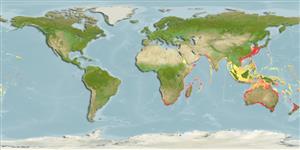
Marine; brackish; demersal; depth range 1 - 200 m (Ref. 4316), usually 75 - 150 m (Ref. 33616). Subtropical; 34°N - 43°S, 15°E - 154°W
Indo-West Pacific: Delagoa Bay, Mozambique to the Cape, South Africa; common in Australia and New Zealand and reported from Japan and Korea. Also reported from Hong Kong (Ref. 12086).
Length at first maturity / Size / Weight / Age
Maturity: Lm21.2 range ? - ? cm Max length : 60.0 cm TL male/unsexed; (Ref. 4316); common length : 40.0 cm TL male/unsexed; (Ref. 9258); max. published weight: 1.5 kg (Ref. 9988); max. reported age: 15 years (Ref. 9072)
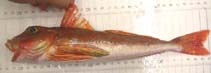
Dorsalspines (total): 9 - 10; Dorsalsoft rays (total): 15 - 16; Analspines: 0; Analsoft rays: 14 - 16; Vertebrae: 33 - 35. Olive or brownish in color, becomes red when stressed; lower half of the inner part of pectoral fin with large black blotch surrounded by numerous pale spots (Ref. 9771). Body shape (shape guide): elongated.
Found from estuaries to edge of continental shelves over sand and sandy shell seabed (Ref. 9258). Reported to be often found in rivers (Ref. 4316). Juveniles may occur in bays (Ref. 33616). Benthic (Ref. 58302). Dorsal spine reported to be venomous (Ref. 9771). Neither anterolateral glandular grooves nor venom gland is present (Ref. 57406). Current information in the table (dangerous fish) do not match; needs verification. Excellent food fish (Ref. 9771). Utilized fresh and frozen; eaten pan-fried, broiled, microwaved and baked (Ref. 9988).