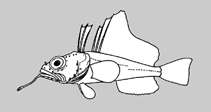
Common names from other countries
Teleostei (teleosts) >
Perciformes/Notothenioidei (Icefishes) >
Artedidraconidae (Barbled plunderfishes)
Etymology: Pogonophryne: Greek, pogon = beard + Greek, phrynos = toad (Ref. 45335); maculiventrata: Name from Latin words 'macula' for spot and 'venter' for belly; referring to its spotted belly.
Environment: milieu / climate zone / depth range / distribution range
Ecology
Marine; demersal; depth range ? - 360 m (Ref. 96821). Polar
Antarctic Atlantic: Antarctica, Bransfield Strait.
Size / Weight / Age
Maturity: Lm ? range ? - ? cm
Max length : 16.4 cm SL (female)
Short description
Identification keys | Morphology | Morphometrics
Dorsal soft rays (total): 30; Anal soft rays: 17; Vertebrae: 38. This species belongs to the 'marmorata' group of the genus Pogonophryne is distinguished by the following characters: spotted thorax and belly; unusual caudal fin colouration with central area divided into 2 parts by light transverse streak, upper proximal and smaller distal parts, and upper edge and tips of rays at the bottom of caudal fin light; esca bearing no cylinder like folds in the form of cerebral surface, well-developed post temporal ridges, mental barbel equals 25.5% of HL, length of esca 48.3% TL of the length of barbel (Ref. 96821).
Body shape (shape guide): elongated; Cross section: angular.
The female specimen collected has eggs in the ovaries which have reached 1.2 mm in diameter (Ref. 96821).
Life cycle and mating behavior
Maturity | Reproduction | Spawning | Eggs | Fecundity | Larvae
Spodareva, V.V. and A.V. Balushkin, 2014. Description of a new species of plunderfish of genus Pogonophryne (Perciformes: Artedidraconidae) from the Bransfield Strait (Antarctica) wit a key for the identification of species of the group "marmorata". J. Ichthyol. 54(1):1-6. (Ref. 96821)
IUCN Red List Status (Ref. 130435: Version 2025-2)
Threat to humans
Harmless
Human uses
Tools
Special reports
Download XML
Internet sources