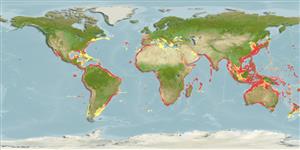
Trichiurus lepturus, Largehead hairtail : fisheries, gamefish
This page is sponsored by
Mundus Maris

Trichiurus lepturus Linnaeus, 1758

Largehead hairtail
Добавить Ваши наблюдения в Fish Watcher
Native range | All suitable habitat | Point map | Year 2050
This map was computer-generated and has not yet been reviewed.
Trichiurus lepturus   AquaMaps   Data sources: GBIF OBIS
Загрузить свой Фото и Видео
изображения | Изображение на Google
Image of Trichiurus lepturus (Largehead hairtail)
Trichiurus lepturus
Изображение сделано Osmany, H.B.


Cuba territory information

Common names: Atlantic Cutlassfish, Sable
Occurrence: native
Salinity: brackish
Abundance: common (usually seen) | Ref: Claro, R., 1994
Importance: minor commercial | Ref: Claro, R., 1994
Aquaculture: | Ref:
Regulations: | Ref:
Uses: no uses
Comments: Caught occasionally. Also Ref. 6181, 26340.
National Checklist:
Territory Information: https://www.cia.gov/library/publications/resources/the-world-factbook/geos/cu.html
National Fisheries Authority:
Occurrences: Occurrences Point map
Main Ref: Claro, R. and L.R. Parenti, 2001
National Database:

Common names from other countries

Классификация / Имена народные названия | синонимы | Catalog of Fishes(род, виды) | ITIS | CoL | WoRMS | Cloffa

> Scombriformes (Mackerels) > Trichiuridae (Cutlassfishes) > Trichiurinae
Etymology: Trichiurus: Greek, thrix = hair + Greek, oura = tail (Ref. 45335)lepturus: Specific name from Greek 'lepturus', for its thin or slender tail.
More on author: Linnaeus.

Окружающая среда: среда / климатическая зона / пределы глубины / диапазон распространения экология

морской; солоноватоводный донно-пелагический; амфидромный (Ref. 51243); пределы глубины 0 - 589 m (Ref. 58018), usually 100 - 350 m (Ref. 35388). Subtropical; 49°N - 54°S, 114°W - 180°E (Ref. 54931)

распространение Территории | регионы FAO | Экосистемы | места находок | карта точек | интродукции | Faunafri

Circumtropical and Circumtemperate: including Gulf of Mexico, Caribbean Sea, Mediterranean Sea, Sea of Marmara, Red Sea, Persian Gulf.

Длина при первой зрелости / Размер / Вес / Возраст

половая зрелость: Lm 50.6, range 30 - 99 cm
Max length : 234 cm TL самец/пол неопределен; (Ref. 26340); common length : 100.0 cm TL самец/пол неопределен; (Ref. 26999); наибольший вес (опубликованные данные): 5.0 kg (Ref. )

Краткое описание определительные ключи | морфология | морфометрия

колючие лучи спинного плавника (общее число) : 3; членистые (мягкие) лучи спинного плавника (общее число) : 130 - 135; членистые (мягкие) лучи анального плавника: 100 - 105. Body extremely elongate, compressed and tapering to a point. Mouth large with a dermal process at the tip of each jaw. Dorsal fin relatively high; anal fin reduced to minute spinules usually embedded in the skin or slightly breaking through; anterior margin of pectoral fin spine not serrated. Pelvic and caudal fins absent. Lateral line beginning at the upper margin of the gill cover, running oblique to behind the tip of the pectoral fins, then straight close to the ventral contour. Fresh specimens steely blue with silvery reflections, becoming uniformly silvery gray sometime after death (Ref. 6181).
Body shape (shape guide): eel-like; Cross section: compressed.

биология     глоссарий (например epibenthic)

Generally over muddy bottoms of shallow coastal waters (Ref. 9351). Often enter estuaries (Ref. 9351). Juveniles feed mostly on euphausiids, small pelagic planktonic crustaceans and small fishes; adults feed mainly on fishes and occasionally on squids and crustaceans (Ref. 6181). Adults and juveniles have opposing complementary vertical diurnal feeding migration. Large adults usually feed near the surface during the daytime and migrate to the bottom at night. Juveniles and small adults form schools 100 m above the bottom during the daytime and form loose feeding aggregations at night near the surface. Pelagic eggs (Ref. 35388) and larvae (Ref. 6768). Max weight of 1.5 kg given in Ref. 28023 seems too low. The current angling world record was caught in Rio de Janeiro's Guanabara Bay and weighed 3.69 kg. Commercial fisherman have caught fish of up to 5 kg (Capt. Eduardo Baumeier, pers. Comm., 2001). Marketed salted or dried and also frozen (Ref. 9351). Excellent taste when fried or grilled; also for sashimi when fresh.

Жизненный цикл и брачное поведение половая зрелость | размножение | нерест | икра | Плодовитость | личинки

Основная ссылка Загрузите свои рекомендации | ссылки | координатор : Parin, Nikolay V. | соавторы

Nakamura, I. and N.V. Parin, 1993. FAO Species Catalogue. Vol. 15. Snake mackerels and cutlassfishes of the world (families Gempylidae and Trichiuridae). An annotated and illustrated catalogue of the snake mackerels, snoeks, escolars, gemfishes, sackfishes, domine, oilfish, cutlassfishes,. scabbardfishes, hairtails, and frostfishes known to date. FAO Fish. Synop. 125(15):136 p. (Ref. 6181)

Статус Красного Списка МСОП (Ref. 130435: Version 2025-2)

  Не вызывающий беспокойства (LC) ; Date assessed: 29 January 2013

CITES

Not Evaluated

CMS (Ref. 116361)

Not Evaluated

Угроза для людей

  Harmless


Использование человеком

рыболовство: важный объект промысла; объект спортивного рыболовства: да

дополнительная информация

Трофическая экология
Пищевые предметы (добыча)
состав пищи
потребление пищи
Продовольственные пайки
хищники
экология
экология
Home ranges
Жизненный цикл
размножение
половая зрелость
Зрелость/Жиры относительно.
Плодовитость
нерест
Нерестовые скопления
икра
Развитие икры
личинки
динамика численности личинок
распространение
Территории
регионы FAO
Экосистемы
места находок
интродукции
BRUVS - Видео
Физиология
Состав тела
Питательные вещества
Потребление кислорода
Тип плавания
Скорость плавания
Зрительные пигменты
Звук рыбы
Болезни и паразиты
Токсичность (LC50s)
генетика
Геном
генетика
Гетерозиготность
наследуемость
Связанные с человеком
Системы аквакультуры
особенности рыбоводства
степень растяжения
Случаи заболевания сигуатерой
Марки, монеты и прочее.
Информационно-просветительская работа
соавторы
ссылки
ссылки

инструменты

Специальные отчеты

Скачать в формате XML

ресурсы в Интернет

Оценки, основанные на моделях

Предпочтительная температура (ссылка 123201): 10.1 - 23.2, mean 15.2 °C (based on 1178 cells).
Индекс филогенетического разнообразия (ссылка 82804):  PD50 = 0.5010   [Uniqueness, from 0.5 = low to 2.0 = high].
Bayesian length-weight: a=0.00035 (0.00029 - 0.00042), b=3.15 (3.10 - 3.20), in cm total length, based on LWR estimates for this species (Ref. 93245).
Трофический уровень (ссылка 69278):  4.4   ±0.4 se; based on diet studies.
Generation time: 2.9 (1.3 - 4.2) years. Estimated as median ln(3)/K based on 15 growth studies.
устойчивость к внешним воздействиям (ссылка 120179):  средний (среднего размера), минимальное время удвоения популяции 1.4-4.4 года (K=0.25-0.29; tm=2-3.7; tmax=15; Fec=21,672).
Prior r = 0.21, 95% CL = 0.14 - 0.32, Based on 3 full stock assessments.
Уязвимость рыбной ловли (Ref. 59153):  Moderate to high vulnerability (52 of 100). 🛈
Климатическая уязвимость (Ref. 125649):  High vulnerability (62 of 100). 🛈
Категория цены (Ref. 80766):   High.
Питательные вещества (Ref. 124155):  Calcium = 100 [30, 212] mg/100g; Iron = 1.23 [0.36, 2.72] mg/100g; Protein = 19.4 [17.7, 21.0] %; Omega3 = 0.256 [0.133, 0.574] g/100g; Selenium = 173 [63, 488] μg/100g; VitaminA = 3.29 [0.71, 21.47] μg/100g; Zinc = 0.855 [0.444, 1.405] mg/100g (wet weight); based on nutrient studies.