Common names from other countries
Miljö: miljö / Klimatzon / djupintervall / distributionsområde
Ekologi
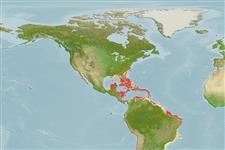
marina revassocierade; havsvandrande (Ref. 51243); djupintervall 1 - 90 m (Ref. 5217). Tropical; 35°N - 34°S, 92°W - 34°W (Ref. 5222)
Western Atlantic: Bermuda, Florida, Bahamas, Yucatan Peninsula and throughout the Caribbean to southern Brazil. Not known from the Gulf of Mexico except at the Campeche Bank off the coast of Yucatan, at Tortugas and off Key West.
Längd vid första mognad / Storlek / Vikt / Ålder
Könsmognad: Lm 48.0 range ? - ? cm
Max length : 122 cm TL hane/ej könsbestämd; (Ref. 5227); publicerad maxvikt: 25.0 kg (Ref. 5222); rapporterad maxålder: 29 år (Ref. 45400)
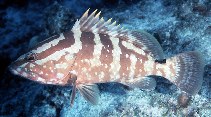
Taggstrålar i ryggfenan (totalt) : 11 - 12; Mjukstrålar i ryggfenan (totalt) : 16 - 18; Taggstrålar i analfenan: 3; Mjukstrålar i analfenan: 8. Caudal fin rounded in juveniles. Dorsal fin notched between forward spines; 3rd or 4th spine the longest. Bases of soft dorsal and anal fins covered with scales and thick skin; scales small and greatly overlapping. Ground color tawny in individuals in shallow water, shading to pinkish or red in those from deeper water, sometimes with an orange cast. Can change color pattern in a few minutes from almost white to uniformly dark brown depending on mood. Third and fourth vertical bars branch above lateral line forming a W-shaped mark. Several distinct black spots below and behind eye and a characteristic `tuning-fork shaped stripe on top of head, dividing just behind the orbits. (see also Refs. 5221, 5222, 5227 and 2458).
Body shape (shape guide): fusiform / normal; Cross section: compressed.
Occurs from the shoreline to at least 90 m depth. Usually close to caves (Ref. 9710). Juveniles are common in seagrass beds. Diet comprises mainly of fishes (54%) and crabs (23%) and lesser amounts of other crustaceans and mollusks. It is solitary and mainly diurnal; but may sometimes form schools. Spawns near the new moon with up to 30,000 aggregating at certain spawning sites (Ref. 9710). The least wary and most friendly of all the groupers (Ref. 5226). Heavily fished and vulnerable to overfishing, particularly when migrating or aggregating to spawn (Ref. 9710). The most important commercial grouper in the West Indies. Marketed fresh, mostly between 2 to 10 kg (Ref. 3708).
Most males and females display a bicolored pattern during spawning. Courtship behavior involves vertical spiral movement, short vertical runs followed by rapid aggregation then rapid dispersal and horizontal runs near the bottom. Sex reversal reportedly between 30 and 80 cm SL. Some primary males found recently (Ref. 5222). Protogyny was assumed in old literature, but dioecism (gonochorism) has been demonstrated. Pelagic spawner (Ref. 31572).
Heemstra, P.C. and J.E. Randall, 1993. FAO Species Catalogue. Vol. 16. Groupers of the world (family Serranidae, subfamily Epinephelinae). An annotated and illustrated catalogue of the grouper, rockcod, hind, coral grouper and lyretail species known to date. Rome: FAO. FAO Fish. Synop. 125(16):382 p. (Ref. 5222)
Status på IUCN:s rödlista (Ref. 130435: Version 2025-2 (Global))
Hot mot människor
Reports of ciguatera poisoning (Ref. 30303)
Mänskliga användningsområden
Fiskeri: kommersiell; sportfisk: ja; Akvarium: Offentliga akvarier
Verktyg
Särskilda rapporter
Ladda ner XML
Internet-källor
Uppskattningar baserade på modeller
Önskad temperatur (Ref.
123201): 22.8 - 28, mean 26.4 °C (based on 400 cells).
Index för fylogenetisk mångfald (Ref.
82804): PD
50 = 0.5000 [Uniqueness, from 0.5 = low to 2.0 = high].
Bayesian length-weight: a=0.01148 (0.01001 - 0.01316), b=3.05 (3.03 - 3.07), in cm total length, based on LWR estimates for this species (Ref.
93245).
Trofisk nivå (Ref.
69278): 4.1 ±0.0 se; based on diet studies.
Resiliens (Ref.
120179): Låg, lägsta populationsfördubblingstid 4,5-14 år (Musick et al. 2000 (Ref.
36717)).
Prior r = 0.43, 95% CL = 0.28 - 0.64, Based on 1 data-limited stock assessment.
Sårbarhet i fisket (Ref.
59153): High vulnerability (63 of 100).
🛈
Sårbarhet för klimatet (Ref.
125649): Very high vulnerability (82 of 100).
🛈
Näringsämnen (Ref.
124155): Calcium = 15.2 [7.2, 34.8] mg/100g; Iron = 0.444 [0.224, 0.890] mg/100g; Protein = 18.4 [16.8, 19.9] %; Omega3 = 0.106 [0.063, 0.178] g/100g; Selenium = 46.3 [23.9, 93.4] μg/100g; VitaminA = 201 [51, 791] μg/100g; Zinc = 0.995 [0.670, 1.432] mg/100g (wet weight);