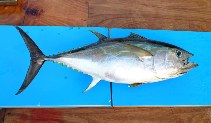
Thunnus obesus, Bigeye tuna : fisheries, gamefish

You can sponsor this page

Thunnus obesus (Lowe, 1839)

Bigeye tuna
Waarneming toevoegen in Fish Watcher
Native range | All suitable habitat | Point map | Year 2050
This map was computer-generated and has not yet been reviewed.
Thunnus obesus   AquaMaps   Data sources: GBIF OBIS
Uploaden van uw Foto's en video's
Afbeeldingen | Postzegels, munten, diversen. | Google afbeelding
Image of Thunnus obesus (Bigeye tuna)
Thunnus obesus
Afbeelding van Chow, S.

Common names from other countries

Classificatie / Namen Lokale namen | Synoniemen | Catalog of Fishes(Genus, Soort(en)) | ITIS | CoL | WoRMS | Cloffa

> Scombriformes (Mackerels) > Scombridae (Mackerels, tunas, bonitos) > Scombrinae
Etymology: Thunnus: Greek, thynnos = tunna (Ref. 45335).
More on author: Lowe.

Milieu: milieu / Klimaatzone / Diepte / verspreidingsgebied Ecologie

marien pelagic-oceanic; oceanodroom (Ref. 71039); diepte 0 - 1500 m (Ref. 117020), usually 0 - 500 m (Ref. 117020). Subtropical; 13°C - 29°C (Ref. 168); 52°N - 48°S, 180°W - 180°E

Verspreiding Gebieden | FAO regio's | Ecosystemen | Voorkomen | Verspreidingskaart | Introducties | Faunafri

Atlantic, Indian and Pacific: in tropical and subtropical waters. Absent in the Mediterranean. Highly migratory species.

Lengte bij maturiteit / Grootte / Gewicht / Leeftijd

Maturiteit: Lm 112.5, range 100 - 125 cm
Max length : 250 cm TL mannelijk / geslacht onbekend; (Ref. 27000); common length : 180 cm FL mannelijk / geslacht onbekend; (Ref. 168); max. gepubliceerd gewicht: 210.0 kg (Ref. 9987); max. gerapporteerde leeftijd: 17 Jaren (Ref. 137697)

Korte beschrijving Determinatiesleutels | Morfologie | Morfometrie

Dorsale stekels (totaal) : 13 - 14; Dorsale zachte stralen (totaal) : 14 - 15; Anale stekels: 0; Anale zachte stralen: 14; Wervels: 39. This large species is distinguished by the following characters: robust, fusiform body, slightly compressed from side to side; total gill rakers on first gill arch 23-31; dorsal fins separated only by a narrow interspace, the second followed by 8-10 finlets; anal fin followed by 7-10 finlets; pectoral fins moderately long (22 to 31% of fork length) in large specimens (over 110 cm FL), but very long (as long as in Thunnus alalunga) in smaller specimens; 2 flaps (interpelvic process) between pelvic fins; very small scales on body; corselet of larger and thicker scales developed, but not very distinct; caudal peduncle very slender, with a strong lateral keel between 2 smaller keels; ventral surface of liver striated; swimbladder present. Colour of back metallic dark blue, lower sides and belly whitish; a lateral iridescent blue band runs along sides in live specimens; first dorsal fin deep yellow, second dorsal and anal fins light yellow, finlets bright yellow edged with black (Ref. 9684).
Body shape (shape guide): fusiform / normal; Cross section: oval.

Biologie     Verklarende woordenlijst (bv. epibenthic)

Occur in areas where water temperatures range from 13°-29°C, but the optimum is between 17° and 22°C. Variation in occurrence is closely related to seasonal and climatic changes in surface temperature and thermocline. Juveniles and small adults school at the surface in mono-species groups or mixed with other tunas, may be associated with floating objects. Adults stay in deeper waters (Ref. 5377). Eggs and larvae are pelagic (Ref. 6390). Feed on a wide variety of fishes, cephalopods and crustaceans during the day and at night (Ref. 9340). Meat is highly prized and processed into sashimi in Japan. Marketed mainly canned or frozen (Ref. 9684), but also sold fresh (Ref. 9340).

Levenscyclus en paargedrag Maturiteit | Voortplanting | Paaien | Eieren | Fecunditeit | Larven

Are multiple spawners that may spawn every 1 or 2 days over several months (Ref. 30330). They spawn over periods of the full moon (Ref. 6390). Spawn throughout the year in tropical waters (Ref. 6390).

Hoofdreferentie Upload uw referenties | Referenties | Coördinator : Collette, Bruce B. | Medewerkers

Collette, B.B. and C.E. Nauen, 1983. FAO Species Catalogue. Vol. 2. Scombrids of the world. An annotated and illustrated catalogue of tunas, mackerels, bonitos and related species known to date. Rome: FAO. FAO Fish. Synop. 125(2):137 p. (Ref. 168)

Status op de Rode Lijst van het IUCN (Ref. 130435: Version 2025-2)

  Kwetsbaar (VU) (A2bd); Date assessed: 15 January 2021

CITES

Not Evaluated

CMS (Ref. 116361)

Not Evaluated

Gevaar voor de mens

  Harmless


Gebruik door de mens

Visserij: van groot commercieel belang; sportvis: ja
FAO - visserij: aanvoer, soortsprofiel; Publication: search | FIRMS - Stock assessments | FishSource | Sea Around Us

Meer informatie

Trofische ecologie
Voedsel (prooien)
Dieetsamenstelling
Voedselconsumptie
Voedselrantsoenen
Predatoren
Ecologie
Ecologie
Home ranges
Levenscyclus
Voortplanting
Maturiteit
Rijpheid/kieuwen rel.
Fecunditeit
Paaien
Paaibestanden
Eieren
Ontwikkeling van de eieren
Larven
Larvale populatiedynamiek
Anatomie
Kieuwoppervlak
Hersenen
Otoliet
Fysiologie
Lichaamssamenstelling
Voedingsstoffen
Zuurstofverbruik
Type zwemmen
Zwemsnelheid
Visuele pigmenten
Vis geluid
Ziekten en parasieten
Toxiciteit (LC50)
Genetica
genoom
Genetica
Heterozygositeit
Erfelijkheid
Menselijk gerelateerd
Aquacultuursystemen
Aquacultuurprofielen
Kweeklijnen
Ciguatera gevallen
Postzegels, munten, diversen.
Outreach
Medewerkers
Referenties
Referenties

Tools

Speciale rapporten

Download XML

Internetbronnen

Schattingen op basis van modellen

Gewenste temperatuur (Ref. 123201): 16.8 - 28.6, mean 26.6 °C (based on 3638 cells).
Fylogenetische diversiteitsindex (Ref. 82804):  PD50 = 0.5039   [Uniqueness, from 0.5 = low to 2.0 = high].
Bayesian length-weight: a=0.01318 (0.01043 - 0.01666), b=3.03 (2.99 - 3.07), in cm total length, based on LWR estimates for this species (Ref. 93245).
Trofisch niveau (Ref. 69278):  4.5   ±0.0 se; based on diet studies.
Generation time: 6.6 (4.4 - 10.4) years. Estimated as median ln(3)/K based on 12 growth studies.
Weerstandsvermogen (Ref. 120179):  Gemiddeld, minimale populatieverdubbelingstijd 1,4-4,4 jaar (K=0.11-0.23; tm=3; tmax=11; Fec=2 million).
Prior r = 0.52, 95% CL = 0.34 - 0.77, Based on 10 full stock assessments.
Kwetsbaarheid van de visserij (Ref. 59153):  High vulnerability (56 of 100). 🛈
Kwetsbaarheid voor het klimaat (Ref. 125649):  Moderate to high vulnerability (47 of 100). 🛈
Prijsklasse (Ref. 80766):   Very high.
Voedingsstoffen (Ref. 124155):  Calcium = 22.1 [12.0, 42.2] mg/100g; Iron = 2.65 [1.06, 6.93] mg/100g; Protein = 24 [23, 25] %; Omega3 = 0.453 [0.273, 0.754] g/100g; Selenium = 54.7 [17.4, 171.5] μg/100g; VitaminA = 19.6 [2.7, 180.1] μg/100g; Zinc = 0.278 [0.153, 0.561] mg/100g (wet weight);