This website uses cookies to enhance your browsing experience and ensure the functionality of our site. For more detailed information about the types of cookies we use and how we protect your privacy, please visit our Privacy Information page.
×
Cookie Settings
This website uses different types of cookies to enhance your experience. Please select your preferences below:
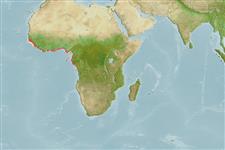
Africa: Atlantic coasts from northern parts of Senegal south to Baie de Saint-Bras in Angola (Ref. 188, 3509), also in lagoons and river estuaries (Ref. 188, 81270).
Length at first maturity / Size / Weight / Age
Maturity: Lm13.0, range 13 - 18 cm Max length : 30.0 cm SL male/unsexed; (Ref. 27000); common length : 16.0 cm SL male/unsexed; (Ref. 188); max. published weight: 144.00 g (Ref. 86940)
Dorsalspines (total): 0; Dorsalsoft rays (total): 14 - 17; Analspines: 0; Analsoft rays: 45 - 50; Vertebrae: 42 - 43. Diagnosis: Body moderately deep, compressed, belly with a sharp and serrated keel of scutes from gill opening to anus, 25-27 pre-pelvic and 6-8 post-pelvic sharp scutes (Ref. 187, 188, 81270). Eye large, mouth pointing upwards, lower jaw projecting (Ref. 187, 188). Dorsal fin at or before midpoint of body; anal fin long, with more than 40 finrays, its origin below dorsal fin base; pelvic fins small (Ref. 187, 188). Swimbladder with two short tubes passing back in the muscles on either side of haemal spines (Ref. 188). Other clupeoid fishes in the area are more slender, have a much shorter anal fin and the lower jaw is not strongly projecting (Ref. 188).
Body shape (shape guide): fusiform / normal; Cross section: compressed.
Found in the marine environment, pelagic, along beaches and just off shore, down to about 25 m, also in lagoons and estuaries, penetrating into almost freshwater (Ref. 187, 188, 54448). A marine migrant (Ref. 117399). Rarely found below 35 m depth (Ref. 86940). It feeds on small planktonic animals, e.g. small fish and crustaceans; it doesn't seem to feed on plankton (Ref. 188, 3166, 47405).
Whitehead, P.J.P., 1985. FAO Species Catalogue. Vol. 7. Clupeoid fishes of the world (suborder Clupeoidei). An annotated and illustrated catalogue of the herrings, sardines, pilchards, sprats, shads, anchovies and wolf-herrings. FAO Fish. Synop. 125(7/1):1-303. Rome: FAO. (Ref. 188)
IUCN Red List Status (Ref. 130435: Version 2025-2)