Common names from other countries
Teleostei (teleosts) >
Ophidiiformes (Cusk eels) >
Ophidiidae (Cusk-eels) > Ophidiinae
Etymology: Genypterus: Greek, geny, -yos = face, jaw + Greek, pteron, = wing, fin (Ref. 45335).
More on author: Forster.
Environment: milieu / climate zone / depth range / distribution range
Ecology
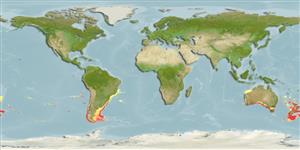
Marine; bathydemersal; oceanodromous (Ref. 51243); depth range 22 - 1000 m (Ref. 58489), usually 300 - 550 m (Ref. 6390). Deep-water; 17°S - 57°S, 114°E - 30°W (Ref. 34024)
Southwest Pacific: southern Australia and around New Zealand. Southeast Pacific: Chile (Ref. 9068). Southwest Atlantic: Brazil (Ref. 4517).
Length at first maturity / Size / Weight / Age
Maturity: Lm 72.0 range ? - ? cm
Max length : 200 cm SL male/unsexed; (Ref. 34024); common length : 100.0 cm TL male/unsexed; (Ref. 9258); max. published weight: 25.0 kg (Ref. 34024); max. reported age: 46 years (Ref. 128769)
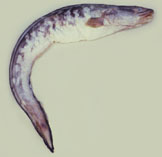
Common species (Ref. 34024). Found between depths of 22 m (Ref. 58489) and 1000 m (Ref. 33848). Feed mainly on crustaceans such as Munida and scampi and also on fish. Also caught above the bottom when feeding on hoki (Macruronus novaezelandiae) during the hoki spawning season. Available all year round. Juveniles are found in shallower shelf waters (Ref. 6390). Oviparous, with oval pelagic eggs floating in a gelatinous mass (Ref. 205). Utilized fresh, frozen or smoked; can be fried and baked (Ref. 9988, 34024).
Nielsen, J.G., D.M. Cohen, D.F. Markle and C.R. Robins, 1999. Ophidiiform fishes of the world (Order Ophidiiformes). An annotated and illustrated catalogue of pearlfishes, cusk-eels, brotulas and other ophidiiform fishes known to date. FAO Fish. Synop. 125(18):178p. Rome: FAO. (Ref. 34024)
IUCN Red List Status (Ref. 130435: Version 2025-2)
Threat to humans
Harmless
Human uses
Fisheries: highly commercial
Tools
Special reports
Download XML
Internet sources