This website uses cookies to enhance your browsing experience and ensure the functionality of our site. For more detailed information about the types of cookies we use and how we protect your privacy, please visit our Privacy Information page.
×
Cookie Settings
This website uses different types of cookies to enhance your experience. Please select your preferences below:
Performance
These cookies help us understand how visitors interact with our website by collecting and reporting information anonymously. For example, we use Google Analytics to generate web statistics, which helps us improve our website's performance and user experience. These cookies may track information such as the pages visited, time spent on the site, and any errors encountered.
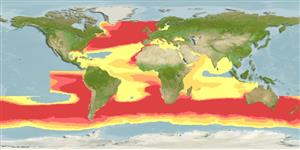
Atlantic, Indian and South Pacific (Ref. 47377). Western Atlantic: Nova Scotia, Canada and Bermuda (Ref. 7251) to Belize and the Antilles (Ref. 26340). Also found in Brazil (Ref. 47377) and in Argentine (Ref. 2806). Eastern Atlantic: central Norway (Ref. 6697) southward to Algoa Bay, South Africa (Ref. 4388). Highly migratory species.
Size / Weight / Age
Maturity: Lm ?  range ? - ? cm Max length : 100.0 cm TL male/unsexed; (Ref. 26340); common length : 40.0 cm SL male/unsexed; (Ref. 3397); max. published weight: 6.0 kg (Ref. 4645); max. reported age: 9 years (Ref. 33866)
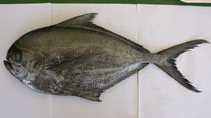
An oceanic and epipelagic species, also found to 1,000 m depth (Ref. 27121). Occasionally comes close to shore (Ref. 9563). Seasonal migrant occurring in small schools, movements apparently temperature-related. Opportunistic feeder on small fishes, cephalopods, amphipods, and euphausiids. Sold fresh and frozen; eaten steamed, fried, broiled and baked (Ref. 9988).
Gomes, J., 1990. Bramidae. p. 758-764. In J.C. Quero, J.C. Hureau, C. Karrer, A. Post and L. Saldanha (eds.) Check-list of the fishes of the eastern tropical Atlantic (CLOFETA). JNCT, Lisbon; SEI, Paris; and UNESCO, Paris. Vol. 2. (Ref. 4936)
IUCN Red List Status (Ref. 130435: Version 2025-2)