Common names from other countries
Miljö: miljö / Klimatzon / djupintervall / distributionsområde
Ekologi
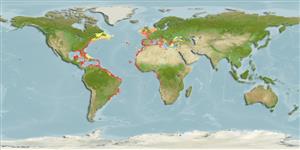
marina; brackvatten pelagic-oceanic; havsvandrande (Ref. 71039); djupintervall 1 - 150 m (Ref. 28173). Tropical; 56°N - 30°S, 92°W - 42°E
Atlantic Ocean: in tropical and subtropical waters, including the Mediterranean, Black Sea, Caribbean Sea and Gulf of Mexico. Highly migratory species
Längd vid första mognad / Storlek / Vikt / Ålder
Könsmognad: Lm 41.8 range ? - 60 cm
Max length : 122 cm TL hane/ej könsbestämd; (Ref. 26340); common length : 80.0 cm TL hane/ej könsbestämd; (Ref. 5217); publicerad maxvikt: 16.5 kg (Ref. 40637); rapporterad maxålder: 10 år (Ref. 28173)
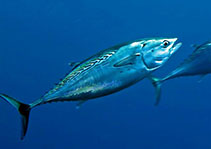
Taggstrålar i ryggfenan (totalt) : 15 - 16; Mjukstrålar i ryggfenan (totalt) : 11 - 13; Taggstrålar i analfenan: 0; Mjukstrålar i analfenan: 11 - 15; Ryggkotor: 39. Anterior spines of first dorsal fin much higher than the those mid-way, giving the fin a strongly concave outline. Interpelvic process small and bifid. Body naked except for corselet and lateral line. Swim bladder absent. Incipient protuberances on 33rd and 34th vertebrae. Back with broken oblique stripes (Ref. 168). Caudal peduncle with 7-8 finlets. Dark stripes on the back and with 3-7 dark spots between pelvic and pectoral fins (Ref. 35388).
Body shape (shape guide): fusiform / normal; Cross section: oval.
Found in neritic waters close inshore (Ref. 13628). This schooling species is an opportunistic predator which feeds on virtually everything within its range, i.e. crustaceans, fishes (mainly clupeoid), squids, heteropods and tunicates. Eggs and larvae are pelagic (Ref. 6769). Specialized traps (madragues) are used in Tunisia and Morocco. Diving bird flocks may indicate large schools (Ref. 9710). Utilized fresh, dried-salted, smoked, canned and frozen (Ref. 9987). A popular game fish (Ref. 9710).
Eggs are shed in several batches when the water is warmest.
Collette, B.B. and C.E. Nauen, 1983. FAO Species Catalogue. Vol. 2. Scombrids of the world. An annotated and illustrated catalogue of tunas, mackerels, bonitos and related species known to date. Rome: FAO. FAO Fish. Synop. 125(2):137 p. (Ref. 168)
Status på IUCN:s rödlista (Ref. 130435: Version 2025-2 (Global))
Hot mot människor
Reports of ciguatera poisoning (Ref. 30303)
Mänskliga användningsområden
Fiskeri: kommersiell; sportfisk: ja
Verktyg
Särskilda rapporter
Ladda ner XML
Internet-källor
Uppskattningar baserade på modeller
Önskad temperatur (Ref.
123201): 11.5 - 27.8, mean 23.3 °C (based on 1094 cells).
Index för fylogenetisk mångfald (Ref.
82804): PD
50 = 0.6250 [Uniqueness, from 0.5 = low to 2.0 = high].
Bayesian length-weight: a=0.01000 (0.00867 - 0.01153), b=3.06 (3.02 - 3.10), in cm total length, based on LWR estimates for this species (Ref.
93245).
Trofisk nivå (Ref.
69278): 4.5 ±0.0 se; based on diet studies.
Resiliens (Ref.
120179): Mellan, lägsta populationsfördubblingstid 1,4-4,4 år (K=0.13-0.22; tm=2; tmax=8; Fec=71,000).
Prior r = 0.57, 95% CL = 0.37 - 0.85, Based on 5 data-limited stock assessments.
Sårbarhet i fisket (Ref.
59153): Moderate vulnerability (41 of 100).
🛈
Sårbarhet för klimatet (Ref.
125649): Moderate vulnerability (40 of 100).
🛈
Näringsämnen (Ref.
124155): Calcium = 15.6 [6.9, 118.0] mg/100g; Iron = 1.86 [0.70, 4.94] mg/100g; Protein = 23.1 [21.1, 24.8] %; Omega3 = 0.228 [0.133, 0.398] g/100g; Selenium = 58.4 [30.9, 111.8] μg/100g; VitaminA = 24.3 [5.5, 105.8] μg/100g; Zinc = 0.487 [0.245, 1.888] mg/100g (wet weight); based on
nutrient studies.