Katsuwonus pelamis, Skipjack tuna : fisheries, gamefish

You can sponsor this page

Katsuwonus pelamis (Linnaeus, 1758)

Skipjack tuna
Beobachtung melden im Fish Watcher
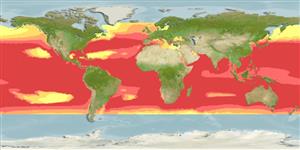
Native range | All suitable habitat | Point map | Year 2050
This map was computer-generated and has not yet been reviewed.
Katsuwonus pelamis   AquaMaps   Data sources: GBIF OBIS
Hochladen Photos und videos
Bilder | videos | Briefmarken, Münzen, Verschiedenes. | Google Bild
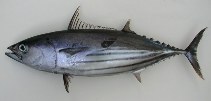
Image of Katsuwonus pelamis (Skipjack tuna)
Katsuwonus pelamis
Male Photo von Freitas, R.


Honduras territory information

Common names: [No common name]
Occurrence: native
Salinity: marine
Abundance: | Ref:
Importance: | Ref:
Aquaculture: | Ref:
Regulations: | Ref:
Uses: no uses
Comments:
National Checklist:
Territory Information: https://www.cia.gov/library/publications/resources/the-world-factbook/geos/ho.html
National Fisheries Authority:
Occurrences: Occurrences Point map
Main Ref: Collette, B.B. and C.E. Nauen, 1983
National Database:

Common names from other countries

Klassifizierung / Names Namen | Synonyme | Catalog of Fishes(Gattung, Arten) | ITIS | CoL | WoRMS | Cloffa

> Scombriformes (Mackerels) > Scombridae (Mackerels, tunas, bonitos) > Scombrinae
More on author: Linnaeus.

Umwelt: Milieu / Klimazone / Tiefenbereich / Verbreitungsgebiet Ökologie

seewasser pelagic-oceanic; ozeanodrom (Ref. 71039); tiefenbereich 0 - 260 m (Ref. 9340), usually 0 - ? m (Ref. 55287). Tropical; 15°C - 30°C (Ref. 168); 63°N - 47°S, 180°W - 180°E

Verbreitung Territorien | FAO Gebiete | Ökosysteme | Vorkommen | Punkt Karte | Einführungen | Faunafri

Cosmopolitan in tropical and warm-temperate waters. Not found in the Black Sea. Highly migratory species,

Länge bei der ersten Reifung / Größe / Gewicht / Alter

Geschlechtsreife: Lm 41.3, range 40 - 45 cm
Max length : 110 cm FL Männchen/unbestimmt; (Ref. 89423); common length : 80.0 cm FL Männchen/unbestimmt; (Ref. 168); max. veröff. Gewicht: 34.5 kg (Ref. 168); max. veröff. Alter: 12 Jahre (Ref. 168)

Kurzbeschreibung Bestimmungsschlüssel | Morphologie | Morphometrie

Rückenflossenstacheln (insgesamt) : 14 - 16; Rückenflossenweichstrahlen (insgesamt) : 14 - 15; Afterflossenstacheln: 0; Afterflossenweichstrahlen: 14 - 15; Wirbelzahl: 41. This species is distinguished by the following characters: body fusiform, elongate and rounded; teeth small and conical, in a single series; gill rakers on first gill arch numerous, 53-63; D1 XIV-XVI, dorsal fins separated by a small interspace (not larger than eye), the second followed by 7-9 finlets; anal fin followed by 7-8 finlets; pectoral fins short, with 26-27 rays; 2 flaps (interpelvic process) between pelvic fins; body scaleless except for corselet and lateral line; a strong keel on each side of caudal-fin base between 2 smaller keels. Colour of back dark purplish blue, lower sides and belly silvery, with 4-6 very conspicuous longitudinal dark bands which in live specimens may appear as discontinuous lines of dark blotches (Ref. 9684).
Body shape (shape guide): fusiform / normal; Cross section: oval.

Biologie     Fachlexikon (Englisch) (z.B. epibenthic)

Found in offshore waters; larvae restricted to waters with surface temperatures of 15°C to 30°C (Ref. 6390). Exhibit a strong tendency to school in surface waters with birds, drifting objects, sharks, whales and may show a characteristic behavior like jumping, feeding, foaming, etc. Feed on fishes, crustaceans, cephalopods and mollusks; cannibalism is common. Spawn throughout the year in the tropics, eggs released in several portions (Ref. 35388). Eggs and larvae are pelagic (Ref. 6769). Preyed upon by large pelagic fishes (Ref. 6885). Also taken by trolling on light tackle using plugs, spoons, feathers, or strip bait (Ref. 9684). Marketed fresh, frozen or canned (Ref. 9340, 9684 ); also dried-salted and smoked (Ref. 9987).

Lebenszyklus und Paarungsverhalten Geschlechtsreife | Fortpflanzung | Ablaichen | Eier | Fruchtbarkeit | Larven

In tropical waters, reproductively active female skipjack tuna spawn almost daily.

Hauptreferenz Laden Sie Ihre Referenzen hoch | Referenzen | Koordinator : Collette, Bruce B. | Partner

Collette, B.B. and C.E. Nauen, 1983. FAO Species Catalogue. Vol. 2. Scombrids of the world. An annotated and illustrated catalogue of tunas, mackerels, bonitos and related species known to date. Rome: FAO. FAO Fish. Synop. 125(2):137 p. (Ref. 168)

IUCN Rote Liste Status (Ref. 130435: Version 2025-2)

  nicht bedroht (LC) ; Date assessed: 15 January 2021

CITES

Not Evaluated

CMS (Ref. 116361)

Not Evaluated

Bedrohung für Menschen

  Reports of ciguatera poisoning (Ref. 4690)


Nutzung durch Menschen

Fischereien: hoch kommerziell; Sportfisch: ja
FAO - Fischereien: landungen, Artbeschreibung; Publication: search | FIRMS - Stock assessments | FishSource | Das Meer um uns herum

Tools

Zusatzinformationen

Download XML

Internet Quellen

Schätzungen auf der Grundlage von Modellen

Bevorzugte Temperatur (Ref. 123201): 13.3 - 29, mean 26.2 °C (based on 8934 cells).
Phylogenetischer Diversitätsindex (Ref. 82804):  PD50 = 1.0000   [Uniqueness, from 0.5 = low to 2.0 = high].
Bayesian length-weight: a=0.01072 (0.00958 - 0.01198), b=3.10 (3.07 - 3.13), in cm total length, based on LWR estimates for this species (Ref. 93245).
Trophische Ebene (Ref. 69278):  4.4   ±0.5 se; based on diet studies.
Generation time: 2.1 (1.8 - 2.4) years. Estimated as median ln(3)/K based on 57 growth studies.
Widerstandsfähigkeit (Ref. 120179):  mittel, Verdopplung der Population dauert 1,4 - 4,4 Jahre. (K=0.3-0.5; tm=2-3; tmax=12; Fec=61,516).
Prior r = 0.52, 95% CL = 0.35 - 0.79, Based on 9 full stock assessments.
Anfälligkeit der Fischerei (Ref. 59153):  Moderate vulnerability (38 of 100). 🛈
Klimaanfälligkeit (Ref. 125649):  Moderate vulnerability (41 of 100). 🛈
Preiskategorie (Ref. 80766):   High.
Nährstoffe (Ref. 124155):  Calcium = 155 [39, 307] mg/100g; Iron = 2.27 [0.81, 7.03] mg/100g; Protein = 22.3 [20.8, 23.6] %; Omega3 = 0.45 [0.22, 1.05] g/100g; Selenium = 87.4 [31.2, 237.6] μg/100g; VitaminA = 6.64 [1.25, 40.76] μg/100g; Zinc = 1.54 [0.37, 3.23] mg/100g (wet weight); based on nutrient studies.