This website uses cookies to enhance your browsing experience and ensure the functionality of our site. For more detailed information about the types of cookies we use and how we protect your privacy, please visit our Privacy Information page.
×
Cookie Settings
This website uses different types of cookies to enhance your experience. Please select your preferences below:
Teleostei (teleosts) > Myctophiformes (Lanternfishes) > Myctophidae (Lanternfishes) > Lampanyctinae
Etymology: Lampanyctus:Greek, lampas, -ados = torch + Greek, nykte = night (Ref. 45335); ritteri:Named after Dr. Ritter, Director of the Scripps Institution of Oceanography (Ref. 6885). Eponymy: Dr William Emerson Ritter (1856–1944) was an American marine biologist and tunicatologist. [...] (Ref. 128868), visit book page. More on author: Gilbert.
Environment: milieu / climate zone / depth range / distribution range Ecology
Marine; bathypelagic; depth range 20 - 1095 m (Ref. 6885). Deep-water; 54°N - 18°N, 135°E - 111°W
Northeast Pacific: British Columbia, Canada to Baja California, Mexico. Bekker (1983) reported a distribution from off Central and South America but this is an error (Ref. 36121). Larvae collected from Taiwan Strait (Ref. 43570).
Size / Weight / Age
Maturity: Lm? range ? - ? cm Max length : 12.0 cm SL male/unsexed; (Ref. 36121)
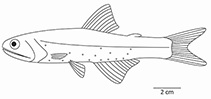
Dorsalspines (total): 0; Dorsalsoft rays (total): 14 - 16; Analspines: 0; Analsoft rays: 18 - 19; Vertebrae: 36 - 38. 15-16 AO photophores; 7-8 tooth patches on lower limb of second gill arch; 35-38 lateral line organs (Ref. 36121). Pectoral fins well developed with rather robust, stout rays (Ref. 36121). Nearly black to metallic blue dorsally, lighter on sides, black in mouth and gill cavity; fins dusky, marked with fine wavy lines (Ref. 6885). Body shape (shape guide): elongated.
Epipelagic to mesopelagic (Ref. 31442). Adults feed on Sagitta, young fishes, copepods, and euphausiids (Ref. 6885). Oviparous, with planktonic eggs and larvae (Ref. 31442). Lipid content is 14.2 % in fresh body weight and wax ester is 58% in total lipids (Ref. 9197).
Zahuranec, B.J., 2000. Zoogeography and systematics of the lanternfishes of the genus Nannobrachium (Myctophidae: Lampanictini). Smithson. Contrib. Zool., 607:1-69. (Ref. 36121)
IUCN Red List Status (Ref. 130435: Version 2025-2)