Common names from other countries
>
Salmoniformes (Salmons) >
Salmonidae (Salmonids) > Salmoninae
Etymology: Oncorhynchus: Greek, onyx, -ychos = nail + Greek, rhyngchos = snout (Ref. 45335); mykiss: Derived from the Kamchatkan name "mikizha" or "mykyz" (Ref. 10294).
More on author: Walbaum.
Miljö: miljö / Klimatzon / djupintervall / distributionsområde
Ekologi
marina; sötvatten; brackvatten bentopelagisk; anadrom (Ref. 138269); djupintervall 0 - 200 m (Ref. 50550). Subtropical; 10°C - 24°C (Ref. 12741); 67°N - 32°N, 135°E - 117°W
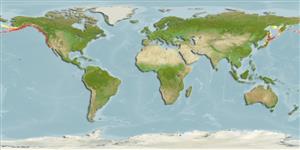
Pacific Slope from Kuskokwim River drainage in Alaska to Otay River drainage in California, USA. Widely introduced and established in Canada and USA, including Arctic, Atlantic, Great Lakes, Mississippi River, and Rio Grande basins, and elsewhere in the world (Ref. 86798). Eastern Pacific: Kamchatkan Peninsula and have been recorded from the Commander Islands east of Kamchatka and sporadically in the Sea of Okhotsk as far south as the mouth of the Amur River along the mainland. The records outside Kamchatka probably represent migrating or straying Kamchatkan steelhead (penshinensis) rather than the established native population (Reg. 50080). Several countries report adverse ecological impact after introduction.
Längd vid första mognad / Storlek / Vikt / Ålder
Könsmognad: Lm ? range ? - ? cm
Max length : 122 cm TL hane/ej könsbestämd; (Ref. 96339); common length : 60.0 cm TL hane/ej könsbestämd; (Ref. 5504); publicerad maxvikt: 25.9 kg (Ref. 120611); rapporterad maxålder: 11 år (Ref. 12193)
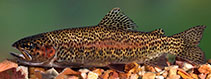
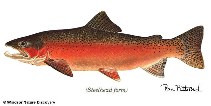
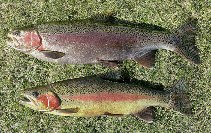
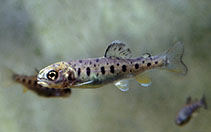
Taggstrålar i ryggfenan (totalt) : 0; Mjukstrålar i ryggfenan (totalt) : 14 - 16; Taggstrålar i analfenan: 0; Mjukstrålar i analfenan: 6 - 12; Ryggkotor: 60 - 66. Diagnosis: Body elongate, somewhat compressed especially in larger fish. No nuptial tubercles but minor changes to head, mouth and color occur especially in spawning males. Colouration varies with habitat, size, and sexual condition; stream residents and spawners darker, colours more intense; lake residents lighter, brighter, and more silvery. Caudal fin with 19 rays (Ref. 2196). Differs from Oncorhynchus gorbuscha by having the following unique characters: anal fin with 6-9½ (usually 8½ ) branched rays; 115-130 scales in midlateral row; 16-17 gill rakers; breeding males lacking hump; juveniles lacking parr marks; wide pink to red stripe from head to caudal base, except in sea-run form; and juveniles with 5-10 parr marks (Ref. 59043).
Body shape (shape guide): fusiform / normal; Cross section: compressed.
Inhabit clear, cold headwaters, creeks, small to large rivers, lakes, and intertidal areas (Ref. 86798). Anadromous in coastal streams (Ref. 5723). Stocked in almost all water bodies as lakes, rivers and streams, usually not stocked in water reaching summer temperatures above 25°C or ponds with very low oxygen concentrations. Feed on a variety of aquatic and terrestrial invertebrates and small fishes. At the sea, they prey on fish and cephalopods. Mature individuals undertake short spawning migrations. Anadromous and lake forms may migrate long distances to spawning streams (Ref. 59043). Utilized fresh, smoked, canned, and frozen; eaten steamed, fried, broiled, boiled, microwaved and baked (Ref. 9988). Cultured in many countries and is often hatched and stocked into rivers and lakes especially to attract recreational fishers (Ref. 9988).
Reported not to establish breeding populations if the peak emergence of fry corresponds to flood season and cold summer temperatures and if temperature does not fall below 13° C (Ref. 59043). Males mature generally at 2 years and females at 3. Spawning happens from November until May in the Northern hemisphere and from August to November on the Southern hemisphere. The size of the eggs depends on the size of the female. In captivity spawning is fostered by abdominal massage. Egg size 3-6 mm, fry length after hatching 12-20 mm. Hatchlings are well developed and equipped with a large yolk sac.
The female finds a spot and digs a pit. While digging, an attendant male courts her or is busy driving away other males. As soon as the pit is completed, the female drops into it and is immediately followed by the male. The pair is side by side, they open their mouth, quiver and release egg and sperm. Females produce from 700 to 4,000 eggs per spawning event (Ref. 4706). At this point, a subordinate male moves in and releases sperm into the nest. The female quickly moves to the upstream edge of the nest and starts digging a new pit, covering the eggs. The whole process is repeated for several days until the female deposits all her eggs (Ref. 27547). Young fish move downstream at night, shortly after emergence (Ref. 4706).
Reproductive strategy: synchronous ovarian organization, determinate fecundity (Ref. 51846).
Page, L.M. and B.M. Burr, 2011. A field guide to freshwater fishes of North America north of Mexico. Boston : Houghton Mifflin Harcourt, 663p. (Ref. 86798)
Status på IUCN:s rödlista (Ref. 130435: Version 2025-2 (Global))
Hot mot människor
Potential pest
Mänskliga användningsområden
Fiskeri: kommersiellt viktig; Vattenbruk: kommersiell; sportfisk: ja
Verktyg
Särskilda rapporter
Ladda ner XML
Internet-källor
Uppskattningar baserade på modeller
Önskad temperatur (Ref.
123201): 1.3 - 10, mean 5.4 °C (based on 315 cells).
Index för fylogenetisk mångfald (Ref.
82804): PD
50 = 0.5000 [Uniqueness, from 0.5 = low to 2.0 = high].
Bayesian length-weight: a=0.00933 (0.00731 - 0.01191), b=3.03 (2.98 - 3.08), in cm total length, based on LWR estimates for this species (Ref.
93245).
Trofisk nivå (Ref.
69278): 4.1 ±0.3 se; based on diet studies.
Generation time: 2.9 ( na - na) years. Estimated as median ln(3)/K based on 1
growth studies.
Resiliens (Ref.
120179): Mellan, lägsta populationsfördubblingstid 1,4-4,4 år (K=0.38-0.46; tm=2-5; tmax=11; Fec=200).
Sårbarhet i fisket (Ref.
59153): Moderate vulnerability (43 of 100).
🛈
Sårbarhet för klimatet (Ref.
125649): Moderate to high vulnerability (52 of 100).
🛈
Näringsämnen (Ref.
124155): Calcium = 29.8 [14.0, 76.9] mg/100g; Iron = 0.917 [0.508, 1.701] mg/100g; Protein = 19.3 [18.4, 20.4] %; Omega3 = 1.04 [0.52, 2.11] g/100g; Selenium = 265 [92, 744] μg/100g; VitaminA = 5.65 [1.46, 22.27] μg/100g; Zinc = 0.523 [0.360, 1.059] mg/100g (wet weight); based on
nutrient studies.