Common names from other countries
>
Scombriformes (Mackerels) >
Scombridae (Mackerels, tunas, bonitos) > Scombrinae
Etymology: Sarda: Latin and Greek, sarda = sardine; name related to the island of Sardinia (Ref. 45335).
More on author: Bloch.
Miljö: miljö / Klimatzon / djupintervall / distributionsområde
Ekologi
marina; brackvatten pelagic-neritic; havsvandrande (Ref. 51243); djupintervall 80 - 200 m (Ref. 5377). Subtropical; 12°C - 27°C (Ref. 168); 62°N - 40°S, 98°W - 42°E (Ref. 54865)
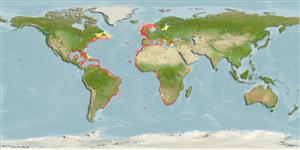
Eastern Atlantic: Oslo, Norway to Port Elizabeth, South Africa. Also known from the Mediterranean and Black Sea. Western Atlantic: Nova Scotia, Canada to Florida, USA and northern Gulf of Mexico; then from Colombia, Venezuela, and south of the Amazon River to northern Argentina; apparently absent from most of the Caribbean Sea.
Längd vid första mognad / Storlek / Vikt / Ålder
Könsmognad: Lm 37.8, range 41 - ? cm
Max length : 91.4 cm FL hane/ej könsbestämd; (Ref. 168); common length : 50.0 cm FL hane/ej könsbestämd; (Ref. 168); publicerad maxvikt: 11.0 kg (Ref. 40637); rapporterad maxålder: 5 år (Ref. 29114)
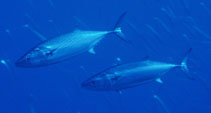
Taggstrålar i ryggfenan (totalt) : 20 - 23; Mjukstrålar i ryggfenan (totalt) : 15 - 18; Taggstrålar i analfenan: 0; Mjukstrålar i analfenan: 14 - 17; Ryggkotor: 50 - 55. Mouth moderately large. Laminae of olfactory rosette 21-39. Interpelvic process small and bifid. Body completely covered with very small scales posterior to the corselet. Swim bladder absent. Spleen large. Liver with elongate left and right lobe and short middle lobe. Oblique dorsal stripes with a greater angle than in other species of Sarda.
Body shape (shape guide): fusiform / normal; Cross section: oval.
Epipelagic, neritic and schooling species that may enter estuaries. Known to be cannibalistic, adults prey on small schooling fishes, invertebrates like squid and shrimps and can swallow relatively large prey. Eggs and larvae pelagic (Ref. 6769). Utilized fresh, dried or salted, smoked, canned and frozen (Ref. 9987). Able to adapt to different temperatures 12° to 27°C and salinities 14 to 39 (Ref. 36731).
Collette, B.B. and C.E. Nauen, 1983. FAO Species Catalogue. Vol. 2. Scombrids of the world. An annotated and illustrated catalogue of tunas, mackerels, bonitos and related species known to date. Rome: FAO. FAO Fish. Synop. 125(2):137 p. (Ref. 168)
Status på IUCN:s rödlista (Ref. 130435: Version 2025-2 (Global))
Hot mot människor
Reports of ciguatera poisoning (Ref. 30303)
Mänskliga användningsområden
Fiskeri: kommersiellt viktig; sportfisk: ja
Verktyg
Särskilda rapporter
Ladda ner XML
Internet-källor
Uppskattningar baserade på modeller
Önskad temperatur (Ref.
123201): 7 - 23.4, mean 10.7 °C (based on 346 cells).
Index för fylogenetisk mångfald (Ref.
82804): PD
50 = 0.5312 [Uniqueness, from 0.5 = low to 2.0 = high].
Bayesian length-weight: a=0.00871 (0.00764 - 0.00993), b=3.06 (3.02 - 3.10), in cm total length, based on LWR estimates for this species (Ref.
93245).
Trofisk nivå (Ref.
69278): 4.5 ±0.0 se; based on diet studies.
Generation time: 2.5 (1.4 - 3.1) years. Estimated as median ln(3)/K based on 14
growth studies.
Resiliens (Ref.
120179): Mellan, lägsta populationsfördubblingstid 1,4-4,4 år (K=0.46; tm>1; tmax=5).
Prior r = 0.57, 95% CL = 0.37 - 0.85, Based on 9 data-limited stock assessments.
Sårbarhet i fisket (Ref.
59153): Low to moderate vulnerability (33 of 100).
🛈
Sårbarhet för klimatet (Ref.
125649): Moderate to high vulnerability (48 of 100).
🛈
Näringsämnen (Ref.
124155): Calcium = 48.6 [29.8, 70.5] mg/100g; Iron = 3.05 [1.93, 4.90] mg/100g; Protein = 21.2 [20.2, 22.1] %; Omega3 = 0.438 [0.198, 0.939] g/100g; Selenium = 34.7 [24.6, 48.6] μg/100g; VitaminA = 9.6 [3.1, 34.2] μg/100g; Zinc = 0.505 [0.409, 0.700] mg/100g (wet weight); based on
nutrient studies.