Common names from other countries
分类 / 名称
俗名 | 同种异名 | Catalog of Fishes(属, 种) | ITIS | CoL | WoRMS | Cloffa
Teleostei >
Cypriniformes (Carps) >
Xenocyprididae (East Asian minnows)
Etymology: Hypophthalmichthys: Greek, hypo = under + Greek, ophthalmos = eye + Greek, ichthys = fish (Ref. 45335); molitrix: molitrix, approximately grinder (referring to the pharyngeal grinding apparatus) (Ref. 10294).
More on author: Valenciennes.
环境:氛围 / 气候带 / 深度上下限 / 分布范围
生态学
; 淡水; 半咸淡水 底中水层性; 河川洄游 (Ref. 51243); 深度上下限 0 - 20 m (Ref. 6898). 溫帶; 6°C - 30°C (Ref. 37797); 63°N - 8°N, 73°E - 148°E (Ref. 120939)
Asia: Native to most major Pacific dainages of East Asia from Amur to Xi Jiang, China (Ref. 59043) and Hanoi, Vietman (Ref. 120939). Introduced around the world for aquaculture and control of algal blooms. Several countries report adverse ecological impact after introduction (Ref. 1739). Often confused with Hypophthalmichthys nobilis (Ref. 59043).
亞洲: 中國與東方西伯利亞。 對於水產業與海藻生長的控制在全世界引入。 引入後的一些國家報告不利的生態衝擊。
首次成熟时的长度 / 大小 / 重量 / 年龄
成熟度: Lm 51.7 range ? - ? cm
Max length : 120 cm TL 雄鱼/尚未辨别雌雄; (Ref. 86798); common length : 18.0 cm SL 雄鱼/尚未辨别雌雄; (Ref. 35840); 最大体重: 50.0 kg (Ref. 30578); 最大年龄: 20 年 (Ref. 121658)
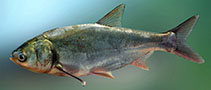
背棘 (总数) : 0; 背的软条 (总数) : 7 - 10; 臀棘: 0; 臀鳍软条: 11 - 17. Diagnosis: Body olivaceous to silvery. Barbels absent. Keels extend from isthmus to anus. Edge of last simple dorsal ray not serrated. Branched anal rays 12-13.5 (Ref. 13274). It differs from Hypophthalmichthys nobilis by having sharp scaleless keel from pectoral region to anal origin, 650-820 long, slender gill rakers, head length 24-29% of standard length, and plain pale coloration, greenish grey above, whitish below (Ref. 59043).
Body shape (shape guide): fusiform / normal; Cross section: oval.
身体橄榄色的到银色的。 触须不存在。 龙骨脊从峡部到肛门延伸。 最后单一的背鳍鳍条的边缘不锯齿状的。 分枝的臀鳍鳍条 12-13.5.(参考文献 13274)
Found in their natural range in rivers with marked water-level fluctuations and overwinters in middle and lower stretches, swimming just beneath the surface. They feed in shallow (0.5-1.0 m deep) and warm (over 21°C) backwaters, lakes and flooded areas with slow current on phytoplankton and zooplankton (Ref. 30578, 10294). Bigger individuals from about 1.5 cm SL feed only on phytoplankton while larvae and small juveniles prey on zooplankton (Ref. 59043). Adults breed in rivers or tributaries over shallow rapids with gravel or sand bottom, in upper water layer or even at surface during floods when the water level increases by 50-120 cm above normal level. Conditions for spawning include high current (0.5-1.7 m/s), turbid water, temperatures above 15°C (usually 18-26°C) and high oxygen concentrations (Ref. 59043). Spawning ceases if conditions change (especially sensitive to water-level fall) and resumes again when water level increases. Juveniles and adults form large schools during spawning season. Mature individuals undertake long distance upriver migration at start of a rapid flood and water-level increase, able to leap over obstacles up to 1 m. After spawning, adults migrate to foraging habitats, In autumn, adults move to deeper places in main course of river where they remain without feeding. Larvae drift downstream and settle in floodplain lakes, shallow shores and backwaters with little or no current (Ref. 59043). In aquaculture, it can survive brackish water (up to 7 ppt) when released into estuaries and coastal lakes (Ref. 59043). Escape from fish farms are widely known even as they are stocked in large rivers and almost all still water bodies like lakes and ponds. Utilized fresh for human consumption and also introduced to many countries where its ability to clean reservoirs and other waters of clogging algae is appreciated even more than its food value (Ref. 9987). One of among 3 or 4 species of cyprinids whose world production in aquaculture exceeds 1 million tons per year (Ref. 30578).
需要不动或缓慢流动的环境例如圈围水域或大河的洄水区。 吃浮游植物与浮游动物。 (参考文献 30578) 在它的原来的分布范围中,它移动溯河到繁殖; 卵与仔鱼漂流物向下到洪泛区区域。 很好地为它在清澈的水中跳跃当被惊扰时的习惯知道的一个活跃的种.(参考文献 7248) 在水面正下方游泳。 (参考文献 5258) 生鲜使用供人类消费以及引进了许多国家在哪里它的能力清理水库与黏砂藻类的其他水域被欣赏甚至超过它的食用价值.(参考文献 9987) 在鲤鱼的 3 或 4 种之中它是 , 水产业全世界产量超过一百万吨每年.(参考文献 30578)
生命周期和交配行为
成熟度 | 繁殖 | 产卵场 | 卵 | 孕卵数 | 仔鱼
亞洲: 中國與東方西伯利亞。 對於水產業與海藻生長的控制在全世界引入。 引入後的一些國家報告不利的生態衝擊。
Skelton, P.H., 1993. A complete guide to the freshwater fishes of southern Africa. Southern Book Publishers. 388 p. (Ref. 7248)
世界自然保护联盟红皮书 (Ref. 130435: Version 2025-2)
人类利用
渔业: 商业性; 养殖: 商业性
工具
特别资料
下载 XML
网络资源
基于模型的估算
系统发育多样性指数 (参考文献
82804): PD
50 = 0.6250 [Uniqueness, from 0.5 = low to 2.0 = high].
Bayesian length-weight: a=0.00891 (0.00772 - 0.01029), b=3.10 (3.06 - 3.14), in cm total length, based on LWR estimates for this species (Ref.
93245).
营养阶层 (参考文献
69278): 2.3 ±0.1 se; based on diet studies.
Generation time: 5.6 (4.5 - 6.8) years. Estimated as median ln(3)/K based on 10
growth studies.
回复力 (参考文献
120179): 中等的, 族群倍增时间最少 1.4 - 4.4年 (K=0.16-0.29; tm=2-6).
渔业脆弱性 (Ref.
59153): High vulnerability (55 of 100).
🛈
营养素 (Ref.
124155): Calcium = 37.9 [16.1, 116.8] mg/100g; Iron = 1.37 [0.69, 2.65] mg/100g; Protein = 17.3 [16.1, 18.5] %; Omega3 = 0.306 [0.176, 0.554] g/100g; Selenium = 30.1 [16.4, 59.9] μg/100g; VitaminA = 8.45 [2.15, 37.85] μg/100g; Zinc = 0.445 [0.263, 0.805] mg/100g (wet weight); based on
nutrient studies.