Common names from other countries
>
Cypriniformes (Carps) >
Xenocyprididae (East Asian minnows)
Etymology: Hypophthalmichthys: Greek, hypo = under + Greek, ophthalmos = eye + Greek, ichthys = fish (Ref. 45335); molitrix: molitrix, approximately grinder (referring to the pharyngeal grinding apparatus) (Ref. 10294).
More on author: Valenciennes.
Môi trường: môi trường / vùng khí hậu / Mức độ sâu / phạm vi phân phối
Sinh thái học
; nước ngọt; thuộc về nước lợ sống nổi và đáy; di cư trong nước ngọt (Ref. 51243); mức độ sâu 0 - 20 m (Ref. 6898). Subtropical; 6°C - 30°C (Ref. 37797); 63°N - 8°N, 73°E - 148°E (Ref. 120939)
Asia: Native to most major Pacific dainages of East Asia from Amur to Xi Jiang, China (Ref. 59043) and Hanoi, Vietman (Ref. 120939). Introduced around the world for aquaculture and control of algal blooms. Several countries report adverse ecological impact after introduction (Ref. 1739). Often confused with Hypophthalmichthys nobilis (Ref. 59043).
Chiều dài lúc trưởng thành đầu tiên / Bộ gần gũi / Khối lượng (Trọng lượng) / Tuổi
Chín muồi sinh dục: Lm 51.7 range ? - ? cm
Max length : 120 cm TL con đực/không giới tính; (Ref. 86798); common length : 18.0 cm SL con đực/không giới tính; (Ref. 35840); Khối lượng cực đại được công bố: 50.0 kg (Ref. 30578); Tuổi cực đại được báo cáo: 20 các năm (Ref. 121658)
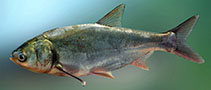
Các tia vây lưng cứng (tổng cộng) : 0; Các vây lưng mềm (tổng cộng) : 7 - 10; Tia cứng vây hậu môn: 0; Tia mềm vây hậu môn: 11 - 17. Diagnosis: Body olivaceous to silvery. Barbels absent. Keels extend from isthmus to anus. Edge of last simple dorsal ray not serrated. Branched anal rays 12-13.5 (Ref. 13274). It differs from Hypophthalmichthys nobilis by having sharp scaleless keel from pectoral region to anal origin, 650-820 long, slender gill rakers, head length 24-29% of standard length, and plain pale coloration, greenish grey above, whitish below (Ref. 59043).
Body shape (shape guide): fusiform / normal; Cross section: oval.
Found in their natural range in rivers with marked water-level fluctuations and overwinters in middle and lower stretches, swimming just beneath the surface. They feed in shallow (0.5-1.0 m deep) and warm (over 21°C) backwaters, lakes and flooded areas with slow current on phytoplankton and zooplankton (Ref. 30578, 10294). Bigger individuals from about 1.5 cm SL feed only on phytoplankton while larvae and small juveniles prey on zooplankton (Ref. 59043). Adults breed in rivers or tributaries over shallow rapids with gravel or sand bottom, in upper water layer or even at surface during floods when the water level increases by 50-120 cm above normal level. Conditions for spawning include high current (0.5-1.7 m/s), turbid water, temperatures above 15°C (usually 18-26°C) and high oxygen concentrations (Ref. 59043). Spawning ceases if conditions change (especially sensitive to water-level fall) and resumes again when water level increases. Juveniles and adults form large schools during spawning season. Mature individuals undertake long distance upriver migration at start of a rapid flood and water-level increase, able to leap over obstacles up to 1 m. After spawning, adults migrate to foraging habitats, In autumn, adults move to deeper places in main course of river where they remain without feeding. Larvae drift downstream and settle in floodplain lakes, shallow shores and backwaters with little or no current (Ref. 59043). In aquaculture, it can survive brackish water (up to 7 ppt) when released into estuaries and coastal lakes (Ref. 59043). Escape from fish farms are widely known even as they are stocked in large rivers and almost all still water bodies like lakes and ponds. Utilized fresh for human consumption and also introduced to many countries where its ability to clean reservoirs and other waters of clogging algae is appreciated even more than its food value (Ref. 9987). One of among 3 or 4 species of cyprinids whose world production in aquaculture exceeds 1 million tons per year (Ref. 30578).
Skelton, P.H., 1993. A complete guide to the freshwater fishes of southern Africa. Southern Book Publishers. 388 p. (Ref. 7248)
Tình trạng Sách đỏ IUCN (Ref. 130435: Version 2025-2)
Mối đe dọa đối với con người
Potential pest
Sử dụng của con người
Các nghề cá: tính thương mại; Nuôi trồng thủy sản: tính thương mại
Các công cụ
Báo cáo đặc biệt
Tải xuống XML
Các nguồn internet
Ước tính dựa trên mô hình
Chỉ số đa dạng phát sinh loài (Tài liệu tham khảo
82804): PD
50 = 0.6250 [Uniqueness, from 0.5 = low to 2.0 = high].
Bayesian length-weight: a=0.00891 (0.00772 - 0.01029), b=3.10 (3.06 - 3.14), in cm total length, based on LWR estimates for this species (Ref.
93245).
Mức dinh dưỡng (Tài liệu tham khảo
69278): 2.3 ±0.1 se; based on diet studies.
Generation time: 5.6 (4.5 - 6.8) years. Estimated as median ln(3)/K based on 10
growth studies.
Thích nghi nhanh (Tài liệu tham khảo
120179): Trung bình, thời gian nhân đôi của chủng quần tối thiểu là 1.4 - 4.4 năm (K=0.16-0.29; tm=2-6).
Sự dễ bị tổn thương của nghề đánh cá (Ref.
59153): High vulnerability (55 of 100).
🛈
Chất dinh dưỡng (Ref.
124155): Calcium = 37.9 [16.1, 116.8] mg/100g; Iron = 1.37 [0.69, 2.65] mg/100g; Protein = 17.3 [16.1, 18.5] %; Omega3 = 0.306 [0.176, 0.554] g/100g; Selenium = 30.1 [16.4, 59.9] μg/100g; VitaminA = 8.45 [2.15, 37.85] μg/100g; Zinc = 0.445 [0.263, 0.805] mg/100g (wet weight); based on
nutrient studies.