This website uses cookies to enhance your browsing experience and ensure the functionality of our site. For more detailed information about the types of cookies we use and how we protect your privacy, please visit our Privacy Information page.
×
Cookie Settings
This website uses different types of cookies to enhance your experience. Please select your preferences below:
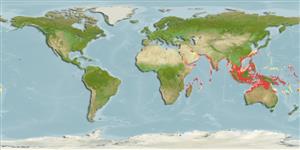
Indo-West Pacific: East Africa (Ref. 2871, 5213, 30573) to Southeast Asia, north to Japan, south to Queensland, Australia. Reported from Fiji (Ref. 12743).
Length at first maturity / Size / Weight / Age
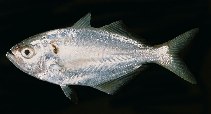
Maturity: Lm15.0 range ? - 19.2 cm Max length : 40.0 cm TL male/unsexed; (Ref. 2872); common length : 30.0 cm TL male/unsexed; (Ref. 2872)
Dorsalspines (total): 8 - 9; Dorsalsoft rays (total): 20 - 22; Analspines: 3; Analsoft rays: 25 - 28. Silvery grey with blue iridescence dorsally, silvery white ventrally; upper part of gill cover with a dusky black spot; fins pale yellow. Mouth large and oblique. Body shape (shape guide): fusiform / normal; Cross section: compressed.
Found in coastal waters down to a depth of about 100 m (Ref. 30573) and between 15-90 m in western Indonesia (Ref. 12260). Feeds on sand-dwelling animals (Ref. 5213). Marketed fresh and dried salted.
Paxton, J.R., D.F. Hoese, G.R. Allen and J.E. Hanley, 1989. Pisces. Petromyzontidae to Carangidae. Zoological Catalogue of Australia, Vol. 7. Australian Government Publishing Service, Canberra, 665 p. (Ref. 7300)
IUCN Red List Status (Ref. 130435: Version 2025-2)