This website uses cookies to enhance your browsing experience and ensure the functionality of our site. For more detailed information about the types of cookies we use and how we protect your privacy, please visit our Privacy Information page.
×
Cookie Settings
This website uses different types of cookies to enhance your experience. Please select your preferences below:
Teleostei (teleosts) > Gadiformes (Cods) > Bregmacerotidae (Codlets)
Etymology: Bregmaceros:Greek, bregma = front of the head + Greek, keras, -atos = horn (Ref. 45335). Eponymy: John McClelland (1805–1875) was a British doctor with interests in geology and natural history. [...] (Ref. 128868), visit book page.
Environment: milieu / climate zone / depth range / distribution range Ecology
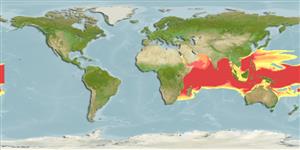
Indian Ocean: confirmed from the Arabian Sea and Bay of Bengal. Reports from outside this area are most likely misidentifications (A.S. Harold, pers. comm., 18/08/98) and name reported from western Pacific may be a misidentification of B. pseudolanceolatus (Ref. 114229).
Size / Weight / Age
Maturity: Lm? range ? - ? cm Max length : 9.6 cm SL male/unsexed; (Ref. 4496); common length : 7.0 cm SL male/unsexed; (Ref. 2872); max. published weight: 8.50 g (Ref. 128684)
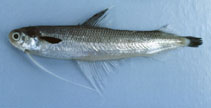
Dorsalspines (total): 0; Dorsalsoft rays (total): 57 - 66; Analspines: 0; Analsoft rays: 58 - 69; Vertebrae: 52 - 58. Body is elongate, brownish and with speckling above and silvery below. The cheek and lower head also silver. Single occipital ray long and delicate, extending to near the middle of the second dorsal fin (Ref. 46075). Pelvic fins are jugular. Body shape (shape guide): elongated; Cross section: oval.
If taxonomy is correct, both onshore in brackish water and oceanic. According to larval survey, occurrence in the tropics is wide (Ref. 9902, 45075). Feed on planktonic crustaceans. Also caught with bagnets (Ref. 2872).
Life cycle and mating behavior Maturity | Reproduction | Spawning | Eggs | Fecundity | Larvae
Cohen, D.M., 1990. Bregmacerotidae. p. 524-525. In J.C. Quero, J.C. Hureau, C. Karrer, A. Post and L. Saldanha (eds.) Check-list of the fishes of the eastern tropical Atlantic (CLOFETA). JNICT, Lisbon; SEI, Paris; and UNESCO, Paris. Vol. 2. (Ref. 4496)
IUCN Red List Status (Ref. 130435: Version 2025-2)