Brama brama, Atlantic pomfret : fisheries

You can sponsor this page

Brama brama (Bonnaterre, 1788)

Atlantic pomfret
Add your observation in Fish Watcher
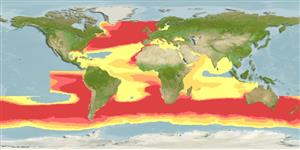
Native range | All suitable habitat | Point map | Year 2050
This map was computer-generated and has not yet been reviewed.
Brama brama   AquaMaps   Data sources: GBIF OBIS
Upload your photos and videos
Bilder | Google image
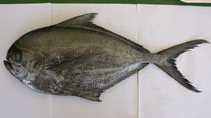
Image of Brama brama (Atlantic pomfret)
Brama brama
Picture by Monteiro, P.


Namibia country information

Common names: Angel, Angelfish, Angelvis
Occurrence: native
Salinity: marine
Abundance: | Ref:
Importance: of no interest | Ref: Okeyo, D.O., 2005
Aquaculture: | Ref:
Regulations: | Ref:
Uses: no uses
Comments: Ranges from Walvis Bay southward (Ref. 4388). Also Ref. 54854.
National Checklist:
Country Information: https://www.cia.gov/library/publications/resources/the-world-factbook/geos/wa.html
National Fisheries Authority: http://www.benefit.org.na/
Occurrences: Occurrences Point map
Main Ref: Bianchi, G., K.E. Carpenter, J.-P. Roux, F.J. Molloy, D. Boyer and H.J. Boyer, 1999
National Database:

Common names from other countries

Classification / Names Populärnamn | synonymer | Catalog of Fishes(Släkte, Arter) | ITIS | CoL | WoRMS | Cloffa

> Scombriformes (Mackerels) > Bramidae (Pomfrets)
Etymology: Brama: Old French, breme, bresme = a fresh water fish; 1460 (Ref. 45335).
More on author: Bonnaterre.

Environment: milieu / climate zone / djupintervall / distribution range Ekologi

marina pelagic-neritic; havsvandrande (Ref. 51243); djupintervall 0 - 1000 m (Ref. 4388), usually 0 - 200 m (Ref. 89422). Subtropical; 12°C - 24°C; 65°N - 70°S, 180°W - 180°E

Utbredning Länder | FAO områden | Ekosystem | Förekomster | Prickkarta | Utplanteringar | Faunafri

Atlantic, Indian and South Pacific (Ref. 47377). Western Atlantic: Nova Scotia, Canada and Bermuda (Ref. 7251) to Belize and the Antilles (Ref. 26340). Also found in Brazil (Ref. 47377) and in Argentine (Ref. 2806). Eastern Atlantic: central Norway (Ref. 6697) southward to Algoa Bay, South Africa (Ref. 4388). Highly migratory species.

Size / Vikt / Age

Könsmognad: Lm ?  range ? - ? cm
Max length : 100.0 cm TL hane/ej könsbestämd; (Ref. 26340); common length : 40.0 cm SL hane/ej könsbestämd; (Ref. 3397); publicerad maxvikt: 6.0 kg (Ref. 4645); rapporterad maxålder: 9 år (Ref. 33866)

Short description Bestämningsnycklar | Morfologi | Morfometri

Taggstrålar i ryggfenan (totalt) : 0; Mjukstrålar i ryggfenan (totalt) : 35 - 38; Taggstrålar i analfenan: 0; Mjukstrålar i analfenan: 29 - 32; Ryggkotor: 41 - 45. Compressed, deep body with a steeply curved head profile (Ref. 33616). Dorsal and anal fins scaled and with rigid fin rays (Ref. 35388).
Body shape (shape guide): short and / or deep.

Biologi     Ordlista (t.ex. epibenthic)

An oceanic and epipelagic species, also found to 1,000 m depth (Ref. 27121). Occasionally comes close to shore (Ref. 9563). Seasonal migrant occurring in small schools, movements apparently temperature-related. Opportunistic feeder on small fishes, cephalopods, amphipods, and euphausiids. Sold fresh and frozen; eaten steamed, fried, broiled and baked (Ref. 9988).

Life cycle and mating behavior Könsmognad | Reproduktion | Lek | Ägg | Fecundity | Larver

Main reference Upload your references | referenser | Koordinator : Thompson, Bruce | Medarbetare

Gomes, J., 1990. Bramidae. p. 758-764. In J.C. Quero, J.C. Hureau, C. Karrer, A. Post and L. Saldanha (eds.) Check-list of the fishes of the eastern tropical Atlantic (CLOFETA). JNCT, Lisbon; SEI, Paris; and UNESCO, Paris. Vol. 2. (Ref. 4936)

IUCN Red List Status (Ref. 130435: Version 2025-1)

  Least Concern (LC) ; Date assessed: 22 May 2013

CITES

Not Evaluated

CMS (Ref. 116361)

Not Evaluated

Threat to humans

  Harmless


Human uses

Fiskeri: kommersiell
FAO - fiskeri: landings; Publication: search | FishSource | Sea Around Us

Ytterligare information

Trophic ecology
Food items (preys)
Födosammansättning
Födointag
Food rations
Predatorer
Ekologi
Ekologi
Home ranges
Life cycle
Reproduktion
Könsmognad
Maturity/Gills rel.
Fecundity
Lek
Spawning aggregations
Ägg
Egg development
Larver
Larvdynamik
Utbredning
Länder
FAO områden
Ekosystem
Förekomster
Utplanteringar
BRUVS - Videos
Anatomy
Gälyta
Brain
Otolith
Physiology
Body composition
Nutrients
Syreförbrukning
Swimming type
Simhastighet
Visual pigments
Fish sound
Diseases & Parasites
Toxicity (LC50s)
Genetik
Genome
Genetik
Heterozygosity
Ärftlighet
Human related
Aquaculture systems
Vattenbruksprofiler
Avelslinjer
Ciguatera cases
Stamps, coins, misc.
Outreach
Medarbetare
referenser
referenser

Verktyg

Special reports

Download XML

Internet-källor

AFORO (otoliths) | Aquatic Commons | BHL | Cloffa | Websites from users | Check FishWatcher | CISTI | Catalog of Fishes: Släkte, Arter | DiscoverLife | ECOTOX | FAO - fiskeri: landings; Publication: search | Faunafri | Fishipedia | Fishtrace | GloBI | Google Books | Google Scholar | Google | IGFA World Record | Nationella databaser | OneZoom | Open Tree of Life | Otolith Atlas of Taiwan Fishes | PubMed | Reef Life Survey | Socotra Atlas | TreeBase | Tree of Life | Wikipedia: Go, sök | World Records Freshwater Fishing | Zoological Record

Estimates based on models

Preferred temperature (Ref. 123201): 6.7 - 23.9, mean 11.8 °C (based on 5684 cells).
Phylogenetic diversity index (Ref. 82804):  PD50 = 0.5039   [Uniqueness, from 0.5 = low to 2.0 = high].
Bayesian length-weight: a=0.01148 (0.00633 - 0.02083), b=3.01 (2.84 - 3.18), in cm total length, based on LWR estimates for this species & (Sub)family-body (Ref. 93245).
Trofisk nivå (Ref. 69278):  4.1   ±0.64 se; based on food items.
Resiliens (Ref. 120179):  Låg, lägsta populationsfördubblingstid 4,5-14 år (Assuming tm>4).
Fishing Vulnerability (Ref. 59153):  High vulnerability (60 of 100). 🛈
Climate Vulnerability (Ref. 125649):  Moderate vulnerability (38 of 100). 🛈
Price category (Ref. 80766):   Low.
Nutrients (Ref. 124155):  Calcium = 14 [5, 56] mg/100g; Iron = 0.476 [0.182, 1.625] mg/100g; Protein = 20 [18, 22] %; Omega3 = 0.322 [0.177, 0.578] g/100g; Selenium = 41.9 [19.0, 86.8] μg/100g; VitaminA = 11.8 [2.8, 48.3] μg/100g; Zinc = 0.397 [0.210, 0.866] mg/100g (wet weight); based on nutrient studies.