Raja montagui, Spotted ray : fisheries

You can sponsor this page

Raja montagui Fowler, 1910

Spotted ray
Add your observation in Fish Watcher
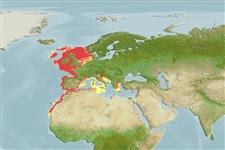
Native range | All suitable habitat | Point map | Year 2050
This map was computer-generated and has not yet been reviewed.
Raja montagui   AquaMaps   Data sources: GBIF OBIS
Upload your photos and videos
Bilder | Videos | Google image
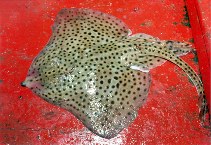
Image of Raja montagui (Spotted ray)
Raja montagui
Picture by Bañón Díaz, R.


Netherlands country information

Common names: Gevlekte rog, Keilrog
Occurrence: native
Salinity: brackish
Abundance: fairly common (chances are about 50%) | Ref: Nijssen, H. and S.J. de Groot, 1974
Importance: | Ref:
Aquaculture: | Ref:
Regulations: | Ref:
Uses: no uses
Comments:
National Checklist:
Country Information: https://www.cia.gov/library/publications/resources/the-world-factbook/geos/nl.html
National Fisheries Authority:
Occurrences: Occurrences Point map
Main Ref: Nijssen, H. and S.J. de Groot, 1974
National Database:

Common names from other countries

Classification / Names Populärnamn | synonymer | Catalog of Fishes(Släkte, Arter) | ITIS | CoL | WoRMS | Cloffa

Elasmobranchii (hajar och rockor) (sharks and rays) > Rajiformes (Skates and rays) > Rajidae (Skates)
Etymology: Raja: Latin, raja, -ae = a sting ray (Raja sp.) (Ref. 45335).
Eponymy: Colonel George Montagu (1751–1815) was a soldier and natural history writer. [...] (Ref. 128868), visit book page.
More on author: Fowler.

Environment: milieu / climate zone / djupintervall / distribution range Ekologi

marina bottenlevande; djupintervall 8 - 530 m (Ref. 88171). Temperate; 61°N - 16°N, 18°W - 25°E

Utbredning Länder | FAO områden | Ekosystem | Förekomster | Prickkarta | Utplanteringar | Faunafri

Eastern Atlantic: Shetlands, southern North Sea and the western Baltic to Mauritania, including the western part of the Mediterranean (to Tunisia and western Greece).

Length at first maturity / Size / Vikt / Age

Könsmognad: Lm 61.0  range ? - ? cm
Max length : 102 cm TL hane/ej könsbestämd; (Ref. 6014); common length : 50.0 cm TL hane/ej könsbestämd; (Ref. 3261); rapporterad maxålder: 18 år (Ref. 88187)

Short description Bestämningsnycklar | Morfologi | Morfometri

Taggstrålar i ryggfenan (totalt) : 0; Taggstrålar i analfenan: 0. Sub-rhomboid in shape with a short rostrum and rounded wing-tips. Upper surface almost smooth in young, but prickly in large specimens, except for bare centers of pectoral fins and hind part of disc, underside nearly smooth; orbital thorns separate, a regular row of 20-50 usually persistent thorns from nape to first dorsal fin; with 1-2 thorns between dorsal fins; 2 equal-sized dorsal fins at end of tail. Brownish dorsally with numerous small dark spots which do not reach the margin of the disc, frequently with a concentration of dark spots forming a ring around a pale centre on hind part of each pectoral fin, underside white (Ref. 3167).
Body shape (shape guide): other; Cross section: flattened.

Biologi     Ordlista (t.ex. epibenthic)

Found mainly along the continental shelf (Ref. 3167). Depth range from 8-283 m in the northeast Atlantic (Ref. 82399), in the southern part of its range it occurs down to 530 m (Ref. 78469, 89037), but most common between 20-120 m (Ref. 88187). Prefers habitats with sand or mud bottoms (Ref. 78469). Juveniles usually found in shallow sandy inshore areas, adults utilize more offshore sand or sand-gravel habitats (Ref. 82399, 89038). Species buries itself to avoid predation and ambush potential prey. Feeds mainly on crustaceans (Ref. 3167) with prey size increasing as it grows (Ref. 88171), also preys on benthic worms, cephalopods and small fishes (Ref. 41849, 58137). Most individuals attain a length of 40-60 cm (Ref. 3261). Oviparous. Young may tend to follow large objects, such as their mother (Ref. 205). Detects weak electric fields generated by other organisms and generate its own weak electric fields (Ref. 10311).

Life cycle and mating behavior Könsmognad | Reproduktion | Lek | Ägg | Fecundity | Larver

Oviparous. Distinct pairing with embrace. Paired eggs are laid during summer (Ref. 3167). Eggs are oblong capsules with stiff pointed horns at the corners deposited in sandy or muddy flats (Ref. 205). Egg capsules are 5.3-7.8 cm long and 3.0-5.0 cm wide (Ref. 41250). Fully formed pups hatch after about 5-6 months and are about 11-12 cm in length (Ref. 78469, 88187).

Main reference Upload your references | referenser | Koordinator : McEachran, John | Medarbetare

McEachran, J.D. and K.A. Dunn, 1998. Phylogenetic analysis of skates, a morphologically conservative clade of elasmobranchs (Chondrichthyes: Rajidae). Copeia 1998(2):271-290. (Ref. 27314)

IUCN Red List Status (Ref. 130435: Version 2025-1)

  Least Concern (LC) ; Date assessed: 14 April 2023

CITES

Not Evaluated

CMS (Ref. 116361)

Not Evaluated

Threat to humans

  Harmless


Human uses

Fiskeri: mindre kommeriell
FAO - fiskeri: landings; Publication: search | FishSource | Sea Around Us

Ytterligare information

Trophic ecology
Food items (preys)
Födosammansättning
Födointag
Food rations
Predatorer
Ekologi
Ekologi
Home ranges
Life cycle
Reproduktion
Könsmognad
Maturity/Gills rel.
Fecundity
Lek
Spawning aggregations
Ägg
Egg development
Larver
Larvdynamik
Utbredning
Länder
FAO områden
Ekosystem
Förekomster
Utplanteringar
BRUVS - Videos
Anatomy
Gälyta
Brain
Otolith
Physiology
Body composition
Nutrients
Syreförbrukning
Swimming type
Simhastighet
Visual pigments
Fish sound
Diseases & Parasites
Toxicity (LC50s)
Genetik
Genome
Genetik
Heterozygosity
Ärftlighet
Human related
Aquaculture systems
Vattenbruksprofiler
Avelslinjer
Ciguatera cases
Stamps, coins, misc.
Outreach
Medarbetare
Taxonomy
Populärnamn
synonymer
Morfologi
Morfometri
Bilder
referenser
referenser

Verktyg

Special reports

Download XML

Internet-källor

AFORO (otoliths) | Aquatic Commons | BHL | Cloffa | Websites from users | Check FishWatcher | CISTI | Catalog of Fishes: Släkte, Arter | DiscoverLife | ECOTOX | FAO - fiskeri: landings; Publication: search | Faunafri | Fishipedia | Fishtrace | GloBI | Google Books | Google Scholar | Google | IGFA World Record | Nationella databaser | OneZoom | Open Tree of Life | Otolith Atlas of Taiwan Fishes | Offentliga akvarier | PubMed | Reef Life Survey | Socotra Atlas | TreeBase | Tree of Life | Wikipedia: Go, sök | World Records Freshwater Fishing | Zoobank | Zoological Record

Estimates based on models

Preferred temperature (Ref. 123201): 7 - 16, mean 9.9 °C (based on 418 cells).
Phylogenetic diversity index (Ref. 82804):  PD50 = 0.5000   [Uniqueness, from 0.5 = low to 2.0 = high].
Bayesian length-weight: a=0.00240 (0.00193 - 0.00299), b=3.25 (3.21 - 3.29), in cm total length, based on LWR estimates for this species (Ref. 93245).
Trofisk nivå (Ref. 69278):  3.9   ±0.2 se; based on diet studies.
Resiliens (Ref. 120179):  Låg, lägsta populationsfördubblingstid 4,5-14 år (K=0.18-0.21; tm=8; tmax=14; Fec=24).
Prior r = 0.40, 95% CL = 0.27 - 0.61, Based on 1 full stock assessment.
Fishing Vulnerability (Ref. 59153):  High vulnerability (58 of 100). 🛈
Climate Vulnerability (Ref. 125649):  High to very high vulnerability (67 of 100). 🛈
Price category (Ref. 80766):   Medium.
Nutrients (Ref. 124155):  Calcium = 5.91 [0.83, 102.85] mg/100g; Iron = 0.244 [0.023, 2.859] mg/100g; Protein = 16.8 [14.0, 19.1] %; Omega3 = 1 [0, 2] g/100g; Selenium = 14.6 [3.0, 72.2] μg/100g; VitaminA = 6.24 [0.46, 70.18] μg/100g; Zinc = 0.34 [0.02, 3.74] mg/100g (wet weight);