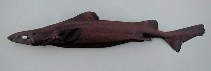
Centroselachus crepidater, Longnose velvet dogfish : fisheries

You can sponsor this page

Centroselachus crepidater (Barbosa, du, Bocage, de, Brito & Capello, 1864)

Longnose velvet dogfish
Upload your photos and videos
Các tranh (Ảnh) | Google image
Image of Centroselachus crepidater (Longnose velvet dogfish)
Centroselachus crepidater
Picture by Cambraia Duarte, P.M.N. (c)ImagDOP


New Zealand country information

Common names: Longnose velvet dogfish, Longnosed velvet dogfish
Occurrence: native
Salinity: marine
Abundance: fairly common (chances are about 50%) | Ref: Doonan, I.J., M. Dunn and A.C. Hart, 2009
Importance: | Ref:
Aquaculture: | Ref:
Regulations: | Ref:
Uses: no uses
Comments: Found in Chathams Island (Ref. 45493). Voucher specimen(s) held at the NMNZ (Ref. 5755). Also Ref. 247, 6577, 75154.
National Checklist:
Country Information: https://www.cia.gov/library/publications/resources/the-world-factbook/geos/nz.html
National Fisheries Authority: http://www.fish.govt.nz/
Occurrences: Occurrences Point map
Main Ref: Cox, G. and M. Francis, 1997
National Database:

Common names from other countries

Classification / Names Tên thường gặp | Các synonym ( Các tên trùng) | Catalog of Fishes(Giống, Các loài) | ITIS | CoL | WoRMS | Cloffa

Lớp phụ Cá sụn (cá mập và cá đuối) (sharks and rays) > Squaliformes (Sleeper and dogfish sharks) > Somniosidae (Sleeper sharks)
Etymology: Centroselachus: centr[um] (L.), prickle or sharp point, referring to spines on both dorsal fins; selachos (Gr.), a cartilaginous fish (i.e., shark or ray) (See ETYFish)crepidater: crepida (L.), low shoe (e.g., slipper); ater (L.), black, transliteration of Portuguese vernacular sapata preta, black shoe, allusion not explained, possibly referring to superficial resemblance to a black velvet slipper [see also Deania calceus, Centrophoridae] (See ETYFish).

Environment: milieu / climate zone / Mức độ sâu / distribution range Sinh thái học

Biển Tầng đáy biển sâu; Mức độ sâu 230 - 1500 m (Ref. 26346). Deep-water; 64°N - 57°S, 77°W - 159°W

Sự phân bố Các nước | Các khu vực của FAO | Các hệ sinh thái | Những lần xuất hiện | Bản đồ điểm | Những chỉ dẫn | Faunafri

Eastern Atlantic: Iceland, Faeroe Islands along Atlantic slope to Portugal, Senegal, Madeira, Gabon to Democratic Republic of the Congo, Namibia (Ref. 247). Indian Ocean: Aldabra and the Travancore coast of India. Western Pacific: New South Wales, Australia and New Zealand. Southeast Pacific: northern Chile.

Length at first maturity / Bộ gần gũi / Khối lượng (Trọng lượng) / Age

Chín muồi sinh dục: Lm 75.4, range 82 - ? cm
Max length : 130 cm TL con đực/không giới tính; (Ref. 6577); Tuổi cực đại được báo cáo: 54 các năm (Ref. 57506)

Short description Khóa để định loại | Hình thái học | Sinh trắc học

Các tia vây lưng cứng (tổng cộng) : 2; Tia cứng vây hậu môn: 0. Black or blackish brown in color, dorsal fins with very small fin spines, very long snout, greatly elongated labial furrows that nearly encircle mouth, lanceolate upper teeth and bladelike lower teeth with moderately long, oblique cusps, fairly slender body that does not taper abruptly from pectoral region, moderately large lateral trunk denticles with partly smooth, oval, cuspidate crowns in adults and subadults (Ref. 247).
Body shape (shape guide): elongated.

Sinh học     Tự điển (thí dụ epibenthic)

A fairly common species found on continental and insular slopes (Ref. 6871), on or near the bottom (Ref. 5578). Feeds mainly on fish and cephalopods (Ref. 6871). Ovoviviparous (Ref. 205), with 4-8 young in a litter (Ref. 6871), born at 28-35 cm (Ref. 26346). The flesh is high in mercury; utilized as fishmeal and source of squalene (Ref. 6871).

Life cycle and mating behavior Chín muồi sinh dục | Sự tái sinh sản | Đẻ trứng | Các trứng | Sự sinh sản | Ấu trùng

Ovoviviparous, with 4-8 young in a litter (Ref. 6871). Born at 28-35 cm (Ref. 26346). Distinct pairing with embrace (Ref. 205).

Main reference Upload your references | Các tài liệu tham khảo | Người điều phối | Người cộng tác

Compagno, L.J.V., 1984. FAO Species Catalogue. Vol. 4. Sharks of the world. An annotated and illustrated catalogue of shark species known to date. Part 1 - Hexanchiformes to Lamniformes. FAO Fish. Synop. 125(4/1):1-249. Rome, FAO. (Ref. 247)

IUCN Red List Status (Ref. 130435: Version 2025-1)

  Near Threatened (NT) (A2bd); Date assessed: 21 November 2019

CITES

Not Evaluated

CMS (Ref. 116361)

Not Evaluated

Threat to humans

  Poisonous to eat (Ref. 6871)


Human uses

Các nghề cá: buôn bán nhỏ
FAO - Các nghề cá: landings; Publication: search | FIRMS - Stock assessments | FishSource | Biển chung quanh ta

Thêm thông tin

Sinh thái dinh dưỡng
Food items (preys)
Thành phần thức ăn
Thành phần thức ăn
Food rations
Các động vật ăn mồi
Sinh thái học
Sinh thái học
Home ranges
Population dynamics
Growth parameters
Max. ages / sizes
Length-weight rel.
Length-length rel.
Length-frequencies
Mass conversion
Bổ xung
Sự phong phú
Life cycle
Sự tái sinh sản
Chín muồi sinh dục
Maturity/Gills rel.
Sự sinh sản
Đẻ trứng
Spawning aggregations
Các trứng
Egg development
Ấu trùng
Sự biến động ấu trùng
Sự phân bố
Các nước
Các khu vực của FAO
Các hệ sinh thái
Những lần xuất hiện
Những chỉ dẫn
BRUVS - Videos
Anatomy
Vùng mang
Brain
Otolith
Physiology
Body composition
Nutrients
Thành phần ô-xy
Dạng bơi
Tốc độ bơi
Visual pigments
Fish sound
Diseases & Parasites
Toxicity (LC50s)
Di truyền
Genome
Di truyền
Heterozygosity
Di sản
Human related
Aquaculture systems
Các tổng quan nuôi trồng thủy sản
Các giống
Ciguatera cases
Stamps, coins, misc.
Các tài liệu tham khảo

Các công cụ

Special reports

Download XML

Các nguồn internet

AFORO (otoliths) | Aquatic Commons | BHL | Cloffa | Websites from users | Check FishWatcher | CISTI | Catalog of Fishes: Giống, Các loài | DiscoverLife | ECOTOX | FAO - Các nghề cá: landings; Publication: search | Faunafri | Fishipedia | Fishtrace | GloBI | Google Books | Google Scholar | Google | IGFA World Record | Các cơ sở dữ liệu quốc gia | OneZoom | Open Tree of Life | Otolith Atlas of Taiwan Fishes | PubMed | Reef Life Survey | Socotra Atlas | TreeBase | Cây Đời sống | Wikipedia: Go, tìm | World Records Freshwater Fishing | Tạp chí Zoological Record

Estimates based on models

Preferred temperature (Tài liệu tham khảo 123201): 2.6 - 10.8, mean 7.8 °C (based on 659 cells).
Phylogenetic diversity index (Tài liệu tham khảo 82804):  PD50 = 1.0000   [Uniqueness, from 0.5 = low to 2.0 = high].
Bayesian length-weight: a=0.00302 (0.00240 - 0.00380), b=3.11 (3.04 - 3.18), in cm total length, based on LWR estimates for this species (Ref. 93245).
Mức dinh dưỡng (Tài liệu tham khảo 69278):  4.2   ±0.4 se; based on diet studies.
Thích nghi nhanh (Tài liệu tham khảo 120179):  Rất thấp, thời gian nhân đôi của chủng quần tối thiểu là hơn 14 năm (Fec=4-8, tmax=54, tm=9-15).
Fishing Vulnerability (Ref. 59153):  Very high vulnerability (78 of 100). 🛈
Climate Vulnerability (Ref. 125649):  Moderate vulnerability (38 of 100). 🛈
Price category (Ref. 80766):   High.
Nutrients (Ref. 124155):  Calcium = 5.64 [1.10, 30.50] mg/100g; Iron = 0.287 [0.069, 0.959] mg/100g; Protein = 20.1 [17.2, 22.3] %; Omega3 = 0.277 [0.101, 0.885] g/100g; Selenium = 18.1 [5.4, 54.3] μg/100g; VitaminA = 12.2 [2.5, 62.2] μg/100g; Zinc = 0.29 [0.14, 0.57] mg/100g (wet weight);