Scomberomorus sierra, Pacific sierra : fisheries, gamefish

You can sponsor this page

Scomberomorus sierra Jordan & Starks, 1895

Pacific sierra
Beobachtung melden im Fish Watcher
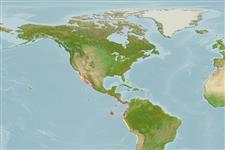
Native range | All suitable habitat | Point map | Year 2050
This map was computer-generated and has not yet been reviewed.
Scomberomorus sierra   AquaMaps   Data sources: GBIF OBIS
Hochladen Photos und videos
Bilder | videos | Google Bild
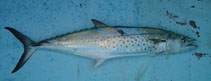
Image of Scomberomorus sierra (Pacific sierra)
Scomberomorus sierra
Photo von Reddish, P.E.


Nicaragua territory information

Common names: Carite sierra
Occurrence: native
Salinity: marine
Abundance: | Ref:
Importance: | Ref:
Aquaculture: | Ref:
Regulations: | Ref:
Uses: no uses
Comments:
National Checklist:
Territory Information: https://www.cia.gov/library/publications/resources/the-world-factbook/geos/nu.html
National Fisheries Authority:
Occurrences: Occurrences Point map
Main Ref: Collette, B.B. and C.E. Nauen, 1983
National Database:

Common names from other countries

Klassifizierung / Names Namen | Synonyme | Catalog of Fishes(Gattung, Arten) | ITIS | CoL | WoRMS | Cloffa

> Scombriformes (Mackerels) > Scombridae (Mackerels, tunas, bonitos) > Scombrinae
Etymology: Scomberomorus: Latin, scomber = mackerel + Greek, moros = silly, stupid (Ref. 45335).
More on authors: Jordan & Starks.

Umwelt: Milieu / Klimazone / Tiefenbereich / Verbreitungsgebiet Ökologie

seewasser pelagic-neritic; ozeanodrom (Ref. 51243); tiefenbereich 10 - 60 m (Ref. 91172). Tropical; 33°N - 27°S, 121°W - 70°W (Ref. 168)

Verbreitung Territorien | FAO Gebiete | Ökosysteme | Vorkommen | Punkt Karte | Einführungen | Faunafri

Eastern Central Pacific: La Jolla in southern California, USA to the Galapagos Islands and Paita, Peru. Recently reported from Antofagasta, Chile. Many authors have erroneously considered this species to be a synonym of Scomberomorus maculatus, or a subspecies of it.

Länge bei der ersten Reifung / Größe / Gewicht / Alter

Geschlechtsreife: Lm 43.9, range 26 - 32 cm
Max length : 99.0 cm FL Männchen/unbestimmt; (Ref. 40637); common length : 60.0 cm FL Männchen/unbestimmt; (Ref. 168); max. veröff. Gewicht: 8.2 kg (Ref. 4699)

Kurzbeschreibung Bestimmungsschlüssel | Morphologie | Morphometrie

Rückenflossenstacheln (insgesamt) : 15 - 18; Rückenflossenweichstrahlen (insgesamt) : 16 - 19; Afterflossenweichstrahlen: 16 - 21; Wirbelzahl: 46 - 49. Interpelvic process small and bifid. Body covered with small scales. Lateral line gradually curving down toward caudal peduncle. Intestine with 2 folds and 3 limbs. Swim bladder absent. Pelvic fins relatively long. Sides silvery with numerous round brownish (orange in life) spots, three rows above lateral line, one above. The first dorsal fin is black distally and white at the base. The second dorsal fin is tinged with yellowish and with black margin. The anal fin is white.
Body shape (shape guide): fusiform / normal; Cross section: oval.

Biologie     Fachlexikon (Englisch) (z.B. epibenthic)

A schooling species believed to spawn close to the coast over most of its range. Adults occur near the surface of coastal waters to over bottom of the continental shelf (Ref. 11035). Adults feed on small fishes, particularly anchovies (Anchoa and Cetengraulis) and clupeids (Odontognathus and Opisthonema). The most abundant game fish along the Pacific coasts of Mexico and Central America. An excellent food fish enough to support a commercial fishery. Marketed fresh and frozen; also used for ceviche (Ref. 9987).

Lebenszyklus und Paarungsverhalten Geschlechtsreife | Fortpflanzung | Ablaichen | Eier | Fruchtbarkeit | Larven

Hauptreferenz Laden Sie Ihre Referenzen hoch | Referenzen | Koordinator : Collette, Bruce B. | Partner

Collette, B.B. and C.E. Nauen, 1983. FAO Species Catalogue. Vol. 2. Scombrids of the world. An annotated and illustrated catalogue of tunas, mackerels, bonitos and related species known to date. Rome: FAO. FAO Fish. Synop. 125(2):137 p. (Ref. 168)

IUCN Rote Liste Status (Ref. 130435: Version 2025-2)

  nicht bedroht (LC) ; Date assessed: 01 September 2022

CITES

Not Evaluated

CMS (Ref. 116361)

Not Evaluated

Bedrohung für Menschen

  Harmless


Nutzung durch Menschen

Fischereien: kommerziell; Sportfisch: ja
FAO - Fischereien: landungen; Publication: search | FishSource | Das Meer um uns herum

Mehr Information

Trophische Ökologie
Lebensmittel (Beutetiere)
Nahrungszusammensetzung
Nahrungsaufnahme
Lebensmittelrationen
Räuber
Ökologie
Ökologie
Home ranges
Populationsdynamik
Wachstumsparameter
Max. Alter/Größen
Länge-Gewicht-Rel.
Länge-Länge-Verhältnis.
Längenhäufigkeiten
Massenkonvertierung
Rekrutierung
Dichte
Lebenszyklus
Fortpflanzung
Geschlechtsreife
Reifung/Kiemen rel.
Fruchtbarkeit
Ablaichen
Laichaggregationen
Eier
Eientwicklung
Larven
Larven Pop.Dyn.
Anatomie
Kiemenoberfläche
Gehirn
Otolith
Physiologie
Körperliche Zusammensetzung
Nährstoffe
Sauerstoffverbrauch
Schwimmart
Schwimmgeschwindigkeit
Visuelle Pigmente
Fischgeräusche
Krankheiten und Parasiten
Toxizität (LC50s)
Genetik
Genom
Genetik
Heterozygotie
Vererbbarkeit
Menschenbezogen
Aquakultur-Systeme
Aquakultur Profile
Zuchtlinien
Ciguatera-Fälle
Briefmarken, Münzen, Verschiedenes.
Aufsuchen
Partner
Referenzen
Referenzen

Tools

Zusatzinformationen

Download XML

Internet Quellen

AFORO (otoliths) | Aquatic Commons | BHL | Cloffa | Websites from users | FishWatcher Einträge suchen | CISTI | Catalog of Fishes: Gattung, Arten | DiscoverLife | ECOTOX | FAO - Fischereien: landungen; Publication: search | Faunafri | Fishipedia | Fishtrace | GloBI | Google Books | Google Scholar | Google | IGFA World Record | OneZoom | Open Tree of Life | Otolith Atlas of Taiwan Fishes | PubMed | Reef Life Survey | RFE Bestimmung | Socotra Atlas | TreeBase | Tree of Life | Wikipedia: Gehe zu, Suchen | World Records Freshwater Fishing | Zoobank | Zoologischer Rekord

Schätzungen auf der Grundlage von Modellen

Bevorzugte Temperatur (Ref. 123201): 19.4 - 28.9, mean 25.8 °C (based on 80 cells).
Phylogenetischer Diversitätsindex (Ref. 82804):  PD50 = 0.5000   [Uniqueness, from 0.5 = low to 2.0 = high].
Bayesian length-weight: a=0.00617 (0.00405 - 0.00940), b=2.93 (2.81 - 3.05), in cm total length, based on LWR estimates for this species & Genus-body shape (Ref. 93245).
Trophische Ebene (Ref. 69278):  4.5   ±0.8 se; based on diet studies.
Widerstandsfähigkeit (Ref. 120179):  mittel, Verdopplung der Population dauert 1,4 - 4,4 Jahre. (Assuming tm=2-4).
Prior r = 0.57, 95% CL = 0.37 - 0.85, Based on 1 data-limited stock assessment.
Anfälligkeit der Fischerei (Ref. 59153):  Moderate to high vulnerability (51 of 100). 🛈
Klimaanfälligkeit (Ref. 125649):  High vulnerability (64 of 100). 🛈
Preiskategorie (Ref. 80766):   Medium.
Nährstoffe (Ref. 124155):  Calcium = 32.7 [14.5, 115.5] mg/100g; Iron = 0.827 [0.363, 2.008] mg/100g; Protein = 20.7 [19.4, 21.9] %; Omega3 = 0.253 [0.153, 0.419] g/100g; Selenium = 54.2 [19.9, 174.5] μg/100g; VitaminA = 23.4 [5.6, 102.0] μg/100g; Zinc = 0.651 [0.429, 1.035] mg/100g (wet weight);