Common names from other countries
>
Cichliformes (Cichlids, convict blennies) >
Cichlidae (Cichlids) > Cichlasomatinae
Etymology: Parachromis: Greek, para = the side of + Greek, chromis = a fish, perhaps a perch (Ref. 45335).
More on author: Günther.
Issue
Reviewed in Kullander & Hartel, 1997, with redescription and photo, and lectotype designation of P. gulosus. Heros managuensis described in more detail in Günther 1868:463, pl. 77 (fig. 3). Reviewed by Bussing (1998: 367), with key, diagnosis, geographical distribution, and figures.
Entorno: milieu / zona climática / rango de profundidad / gama de distribución
Ecología
; agua dulce bentopelágico; pH range: 7.0 - 8.7; dH range: 10 - 15; rango de profundidad 3 - 10 m (Ref. 80549). Tropical; 25°C - 36°C (Ref. 36880); 37°N - 9°N
Central America: Atlantic slope from the Ulua River (Honduras) to the Matina River (Costa Rica).
Tamaño / Peso / Edad
Madurez: Lm ? range ? - ? cm
Max length : 55.0 cm TL macho / no sexado; (Ref. 40637); peso máximo publicado: 1.6 kg (Ref. 40637)
Descripción breve
Claves de identificación | Morfología | Morfometría
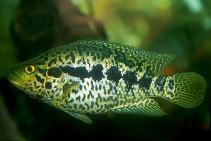
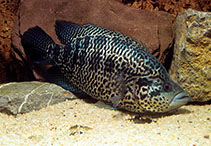
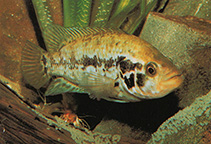
Espinas dorsales (total) : 17 - 18; Radios blandos dorsales (total) : 10 - 11; Espinas anales: 6 - 8; Radios blandos anales: 11 - 12. This species is distinguished by its large mouth, projecting lower jaw, prominent enlarged canine teeth, black spots on fins and body, a more or less continuous black stripe between the eye and opercular margin, another between the eye and the lower angle of the opercle; a row of black blotches along the middle of the side. Distinguished from other members of the genus by having the preopercle expanded at the angle. Body color silvery or golden-green to purple; back moss green, sides with purple iridescence, belly whitish or yellowish; dorsal, anal and caudal fins with numerous black spots, interspaces whitish, yellowish or with blue iridescence; a black blotch on the caudal-fin base. Breeding females with stronger crimson hue to the gill cover.
Body shape (shape guide): fusiform / normal; Cross section: oval.
Inhabits lakes, preferring turbid waters and mud bottoms of the highly eutrophic lakes (Ref. 7335). Found in springs and ponds over detritus and sand bottom (Ref. 5723). Commonly found in very warm, oxygen depleted inundation lakes (Ref. 8978). Highly predaceous, feeding mainly on small fishes and macroinvertebrates (Ref. 7335; 44091). Oviparous, spawns in batches (Ref. Highly esteemed as food fish (Ref. 44091). Maximum length 63 cm TL (Ref. 5723).
Ciclo vital y comportamiento de apareamiento
Madurez | Reproducción | Puesta | Huevos | Fecundidad | Larva
Deposits up to 5,000 eggs on rocks and other hard substrates; both parents guard the eggs and resulting fry (Ref. 44091). Reported to deposit up to 10,496 eggs (Ref. 80549).
Kullander, S.O., 2003. Cichlidae (Cichlids). p. 605-654. In R.E. Reis, S.O. Kullander and C.J. Ferraris, Jr. (eds.) Checklist of the Freshwater Fishes of South and Central America. Porto Alegre: EDIPUCRS, Brasil. (Ref. 36377)
Situación en la Lista Roja de la UICN (Ref. 130435: Version 2025-2)
Amenaza para el ser humano
Potential pest
Usos humanos
Pesquerías: comercial; Acuicultura: comercial; pesca deportiva: si; Acuario: Comercial
Herramientas
Informes especiales
Descargar XML
Fuentes de Internet
Estimaciones basadas en modelos
Índice de diversidad filogenética (Referencia
82804): PD
50 = 0.5312 [Uniqueness, from 0.5 = low to 2.0 = high].
Bayesian length-weight: a=0.02089 (0.01332 - 0.03278), b=3.06 (2.93 - 3.19), in cm total length, based on LWR estimates for this species & (Sub)family-body (Ref.
93245).
Nivel trófico (Referencia
69278): 4.0 ±0.59 se; based on food items.
Resiliencia (Referencia
120179): Medio, población duplicada en un tiempo mínimo de 1.4-4.4 años (Assuming tm=1-2; Fec=10,000).
Vulnerabilidad pesquera (Ref.
59153): Moderate vulnerability (42 of 100).
🛈